
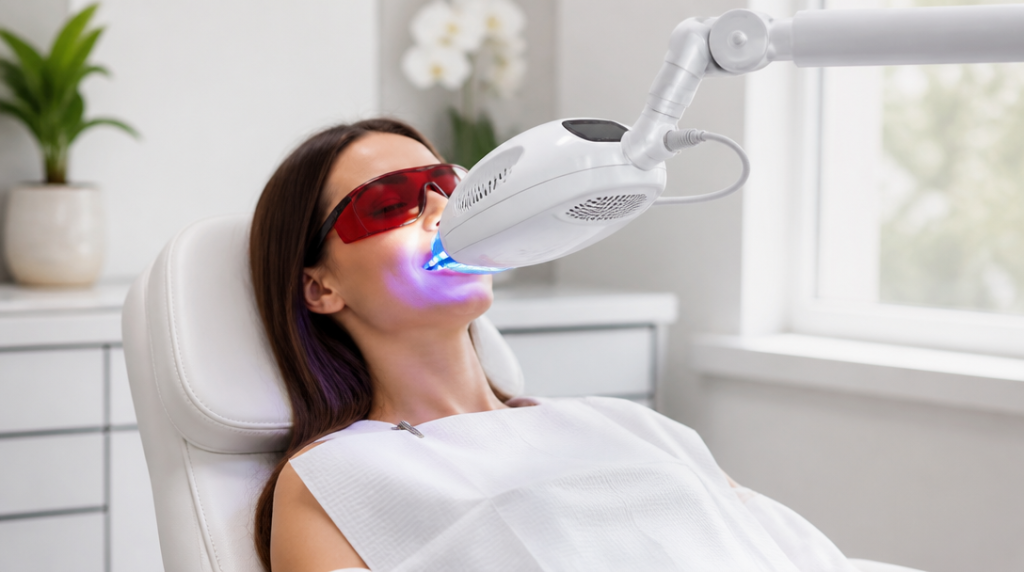
LED Whitening Lamp Specs That Matter When Sourcing
I’ve sat across from enough suppliers at trade shows to know the routine. They flip open a brochure, point to “48 high-power LEDs,” and act like the sale is done. Here’s the thing: LED count tells you almost nothing about whether that lamp will deliver consistent clinical results, pass regulatory scrutiny, or still be serviceable … Read more
I’ve sat across from enough suppliers at trade shows to know the routine. They flip open a brochure, point to “48 high-power LEDs,” and act like the sale is done. Here’s the thing: LED count tells you almost nothing about whether that lamp will deliver consistent clinical results, pass regulatory scrutiny, or still be serviceable eighteen months after you unbox it. Professional buyers need a sharper framework. This article gives you one—built around the technical and commercial specs that actually separate viable suppliers from packaging houses.
Why Wavelength and Irradiance Matter More Than LED Count
Let’s start with the number that actually drives photochemical response: wavelength. Recent clinical research has investigated violet LED systems in the 405–410 nm range for teeth whitening applications, distinct from the broader “blue light” category (typically 450–490 nm) that dominates older product marketing. That distinction matters because gel chemistry is tuned to specific activation spectra; a lamp emitting at 450 nm may look similar to the naked eye but will interact differently with your peroxide formulation.
Irradiance—measured in milliwatts per square centimeter (mW/cm²)—determines how much energy actually reaches the tooth surface. Two lamps with identical LED counts can differ substantially in irradiance depending on optics, distance from the arch, and thermal management. When evaluating specs, demand irradiance measurements at the intended working distance from the arch, not at the LED surface. Surface measurements are clinically uninformative because irradiance drops with distance according to the inverse-square law.
The 405–410 nm violet LED systems in recent trials showed characteristics worth noting. A double-blind randomized controlled trial published in Photodiagnosis and Photodynamic Therapy (2021) evaluated in-office tooth whitening with a 405 nm violet LED and found measurable whitening effects, though outcomes varied by protocol. A parallel clinical trial published in Photobiomodulation, Photomedicine, and Laser Surgery (2021) compared a violet LED system against conventional in-office bleaching over a 6-month follow-up, finding that traditional high-concentration peroxide methods produced stronger color change while the violet LED group reported favorable sensitivity profiles. What this means for LED whitening lamp sourcing: wavelength is a starting point, not a guarantee. The supplier should specify not just “violet LED” or “blue LED” but the exact peak wavelength and bandwidth (FWHM, full width at half maximum).
Here’s a practical screening question for your RFQ: “What is the irradiance at your recommended working distance, and what is the spectral bandwidth at 50% peak power?” Suppliers who cannot answer with test data—third-party test data, not in-house claims—should drop down your shortlist. Fast.

How Gel Chemistry Dictates Which LED System You Can Use
This is where sourcing gets operationally complex. Your lamp and your gel are not independent purchases; they’re a system. The clinical trial literature makes this explicit. The 2021 parallel trial found that violet LED alone produced less color change than peroxide-based protocols over a 6-month follow-up period, while LED combined with carbamide peroxide produced more competitive results. A 2024 study in Lasers in Medical Science compared whitening efficacy and tooth sensitivity across different hydrogen peroxide concentrations photoactivated with violet or blue LEDs, finding that lower-concentration hydrogen peroxide with violet LED achieved whitening outcomes closer to higher-concentration protocols, with differences in sensitivity profiles.
The mechanism is straightforward enough. Peroxide gels release reactive oxygen species through chemical decomposition; LED irradiance can accelerate this through photochemical activation and localized thermal effects. But the activation spectrum varies by peroxide type and concentration. Hydrogen peroxide formulations at higher concentrations have different reaction kinetics than lower-concentration carbamide peroxide products. Some gel formulations include photo-initiators designed for activation within a specific wavelength band. Others rely on broader-spectrum energy absorption.
When sourcing, you need compatibility documentation between the lamp and your intended gel—or you need to commit to the supplier’s gel ecosystem. I’ve seen clinics buy a premium violet-band lamp then discover their existing gel supplier’s formulation is optimized for a blue-band wavelength. The lamp works; it just works poorly. The clinical evidence suggests that proper lamp-gel pairing can let you use gentler formulations without proportional loss of efficacy—a meaningful selling point for sensitivity-conscious patient populations.
Your supplier should provide: spectral absorption data for their recommended gels, temperature rise profiles during standard exposure protocols, and cross-compatibility statements or warnings. If they sell lamp and gel as a locked system, negotiate gel supply terms upfront. Don’t discover you’re captive to steep markup on consumables after you’ve deployed five chairs.
CE Medical Device Classification vs. FDA Clearance: What Your Lamp Actually Needs
Regulatory positioning is where suppliers often obfuscate, and where buyers get burned. Let’s be direct about what the frameworks require.
In the EU, the Medical Device Regulation (EU) 2017/745 (MDR) governs classification, technical documentation, conformity assessment, and CE marking for professional whitening systems marketed as medical devices. The critical phrase is “marketed as medical devices.” A supplier may position an LED lamp as a general-purpose cosmetic light accessory—outside the scope of MDR—if no medical or therapeutic claims are made. The moment the intended purpose includes clinical teeth bleaching or whitening, device classification rules apply. For B2B buyers running dental clinics or medical spas, this distinction is everything. Your liability, your insurance, your professional licensing—all assume you’re using appropriately classified equipment for clinical procedures.
In the US, the FDA regulates dental devices used for teeth bleaching under its device classification framework. The relevant product code and regulation (21 CFR Part 872) cover devices intended to assist in bleaching teeth. The FDA pathway that matters most for sourcing is the 510(k) premarket notification, which establishes that a device is substantially equivalent to a legally marketed predicate. But here’s what trips up buyers: some suppliers sell LED lamps without 510(k) clearance by limiting their claims to general illumination or cosmetic use. This is a risky position for your business if you intend to market a clinical whitening service. The FDA also requires establishment registration and device listing for manufacturers and importers of regulated dental devices.
What to verify: For EU supply, ask for the CE certificate issued under MDR (not the legacy Medical Devices Directive, which is no longer valid for new certifications). Check the notified body number and confirm the certificate specifies the device classification applicable to active therapeutic devices. For US supply, request the 510(k) clearance number and verify it in the FDA’s publicly searchable 510(k) database. Cross-check that the cleared indications for use match how you plan to market the service. A clearance for “auxiliary illumination during dental procedures” is not the same as “activation of bleaching gel.”
One more trap: some suppliers hold a 510(k) for a specific model, then ship a “functionally equivalent” variant with different LED arrays or power supplies. The clearance does not automatically transfer to modified configurations. Get the specific model number from the clearance letter and match it to your purchase order.
Freestanding vs. Chair-Mount vs. Handheld: Matching Format to Service Model
The physical format of your LED whitening lamp shapes your operatory workflow, your staffing model, and your per-patient throughput. There’s no universal best choice; there’s only best fit.
Freestanding units with rolling bases offer flexibility. You can position between chairs, move to consultation rooms for demonstrations, or store when not in use. The tradeoff is footprint and stability. In a high-volume clinic, the thirty seconds spent positioning a freestanding lamp per patient adds up to real capacity loss. Freestanding units also tend to have larger LED arrays, which can mean more uniform arch coverage but also higher power consumption and thermal load.
Chair-mount systems integrate with your dental unit delivery system. They’re always positioned, always powered, and typically offer the most precise distance control. For practices where whitening is a core service—say, 15+ procedures weekly—this integration pays for itself in workflow efficiency. The sourcing consideration: verify mounting compatibility with your chair manufacturer. Adapter plates are often custom or semi-custom; lead times can stretch to 8–12 weeks if the supplier doesn’t stock your configuration.
Handheld or portable units serve a different market entirely. Mobile hygiene services, spa pop-ups, home-visit dentists, and retail demonstration environments need battery-powered portability. Market demand spans both professional and home-use kit categories, and OEMs often produce both clinic-grade and portable models. If you’re sourcing for a multi-channel business, negotiate a supplier relationship that covers both formats. The alternative—dual supplier relationships—doubles your quality audit burden and complicates spare parts inventory.
Battery chemistry deserves attention for handheld units. Lithium-ion cells degrade with thermal cycling, and LED whitening lamps generate heat. Ask for cycle life specifications and whether batteries are field-replaceable or sealed-unit disposal. A “portable” lamp with a 300-cycle battery that requires factory replacement is not truly portable for sustained commercial use.
Evaluating Supplier Test Reports: Irradiance Decay, Heat Output, and Duty Cycle
Suppliers love to show you a test report. Most buyers glance at the pass/fail column and move on. Here’s what actually deserves scrutiny.
Irradiance decay over the lamp’s rated lifetime tells you when clinical efficacy will drop below therapeutic threshold. LEDs don’t fail catastrophically; they degrade. A 30% irradiance drop may mean your 20-minute protocol now needs significantly longer to deliver an equivalent energy dose—or it means suboptimal results that patients notice at follow-up. Demand decay curves, not single-point measurements. Reputable LED manufacturers test to LM-80 standards or equivalent; ask for the test duration (typically 6,000 hours minimum) and the projected L70 lifetime (hours to 70% of initial output).
Heat output affects both patient comfort and gel stability. Clinical trial protocols consistently measure post-whitening sensitivity as a key outcome, making thermal management a practical performance metric for supplier comparison. Excessive thermal rise can degrade peroxide gel prematurely, reducing efficacy, or contribute to pulpal irritation. Your supplier should provide temperature rise data at the tooth surface during standard exposure protocols—measured with thermocouples or thermal imaging, not calculated from theoretical models. Published dental research generally considers a pulp chamber temperature rise exceeding 5.5°C a risk threshold; the lamp’s thermal management should keep surface temperatures well below this under normal operating conditions.
Duty cycle defines how many consecutive procedures the lamp can perform without cooldown. In a busy practice, you may run four whitening appointments back-to-back on a Saturday. A lamp rated for 50% duty cycle (20 minutes on, 20 minutes off) becomes a bottleneck. The specification to request: maximum continuous operating time and required cooldown interval. Then verify this against your actual appointment template.
One more report to request: electromagnetic compatibility (EMC) testing. LED drivers can generate conducted and radiated emissions that interfere with other dental equipment—ultrasonic scalers, apex locators, digital sensors. This is especially relevant for chair-integrated units sharing electrical infrastructure with other devices.
MOQ Structures, Spare-Part Access, and Total Cost of Ownership
Unit price is the least informative number on a supplier’s quotation. For professional LED whitening lamps, total cost of ownership spans 3–5 years and includes consumables, spare parts, calibration, and downtime.
MOQ structures vary dramatically by supplier type. Large OEM factories may require 50–100 unit MOQs for custom configurations but offer 10-unit MOQs for standard models. Trading companies often have no MOQ but add significant margin and limited technical support. For your first sourcing relationship, consider starting with a standard model at moderate MOQ (10–20 units) to validate quality and service before committing to custom tooling.
Spare-part access is where many supplier relationships fracture. LED arrays, driver boards, and optical lenses are the high-failure components. Ask specific questions: Are replacement LED modules stocked or made-to-order? What is the typical lead time for driver boards? Is there a depot repair program, or must failed units be shipped overseas for warranty service? A supplier with regional service centers and rapid spare parts availability may justify a higher unit cost versus a lowest-bidder with multi-week repair cycles.
Consumables lock-in deserves scrutiny. Some lamps use proprietary light guides, disposable barriers, or calibration tools available only from the original supplier. These costs accumulate predictably. Before signing, model your annual consumables spend based on projected procedure volume. I’ve seen clinics discover that a lower-priced lamp generates far higher annual consumables spend than a pricier competitor with universal accessories. Run the five-year math before the purchase order, not after.
Warranty terms are negotiable, especially at volume. Standard is typically 12 months parts and limited labor coverage. For orders above 25 units, push for extended warranty, loaner-unit programs during repair, and guaranteed spare-parts availability for a minimum of three years post-purchase. Get these terms in writing as part of your supply agreement—not as verbal assurances at a trade show booth.
Building Your LED Whitening Lamp Sourcing Checklist
Pull all of this together into a single evaluation framework before your next RFQ cycle. Every prospective supplier should provide documented answers to the following before they reach your shortlist:
- Peak emission wavelength and FWHM bandwidth, verified by third-party spectral measurement
- Irradiance at the recommended working distance, with measurement methodology stated
- Gel compatibility documentation: which formulations have been tested, at what concentrations, with what results
- Regulatory clearance documentation: CE certificate under MDR with notified body number, or FDA 510(k) number with matching model designation
- Thermal rise data at the tooth surface under standard protocol conditions
- Irradiance decay curve with projected L70 lifetime
- Duty cycle rating: maximum continuous run time and required cooldown
- EMC test report confirming compliance with applicable standards
- Spare-parts lead times and availability commitment
- Consumables pricing and lock-in terms
- Warranty duration, coverage scope, and service logistics
Suppliers who can answer all eleven points with documentation—not marketing copy—are the ones worth your next factory visit. The rest are selling you a housing with LEDs in it.
References
- Bispo, L.H.P., et al. “Clinical evaluation of in-office tooth whitening with violet LED (405 nm): A double-blind randomized controlled clinical trial.” Photodiagnosis and Photodynamic Therapy, 2021. PMID: 34116249. https://pubmed.ncbi.nlm.nih.gov/34116249/
- Machado, L.R., et al. “Longitudinal, Randomized, and Parallel Clinical Trial Comparing a Violet Light-Emitting Diodes System and In-Office Dental Bleaching: 6-Month Follow-Up.” Photobiomodulation, Photomedicine, and Laser Surgery, 2021. PMID: 33567218. https://pubmed.ncbi.nlm.nih.gov/33567218/
- Machado, L.R., et al. “Clinical comparison of whitening efficacy and tooth sensitivity of different concentrations of hydrogen peroxide photoactivated with violet or blue LEDs.” Lasers in Medical Science, 2024. PMID: 39060473. https://pubmed.ncbi.nlm.nih.gov/39060473/
- Regulation (EU) 2017/745 of the European Parliament and of the Council on medical devices (MDR). https://eur-lex.europa.eu/legal-content/EN/TXT/?uri=CELEX%3A32017R0745
- U.S. FDA — 21 CFR Part 872: Dental Devices. https://www.ecfr.gov/current/title-21/chapter-I/subchapter-H/part-872
Disclaimer
This article is for informational purposes only. LLRNCARE makes no representations or warranties about the completeness, accuracy, or reliability of the information. Any reliance is at your own risk.
For professional dental advice, consult a qualified dental professional.