
Red Light Therapy Devices for Gum Health: Do They Work
Red light therapy devices for gum health are generating serious commercial interest as the broader photobiomodulation market expands into oral care. But most of what buyers encounter is marketing dressed in lab-coat language. Having spent years watching wellness devices get repackaged for new body parts, the gum health category follows a familiar script. This article … Read more
Red light therapy devices for gum health are generating serious commercial interest as the broader photobiomodulation market expands into oral care. But most of what buyers encounter is marketing dressed in lab-coat language. Having spent years watching wellness devices get repackaged for new body parts, the gum health category follows a familiar script. This article examines what photobiomodulation actually does to gingival tissue, which wavelengths have clinical backing, and what B2B buyers need to verify before putting these devices on shelves.
How Photobiomodulation Affects Gum Tissue at the Cellular Level
Photobiomodulation (PBM) works through a mechanism that sounds simple but gets complicated fast. Red and near-infrared light penetrates tissue and is absorbed by cytochrome c oxidase in mitochondria. This absorption increases adenosine triphosphate (ATP) production, reduces oxidative stress, and modulates inflammatory cytokines. In gum tissue specifically, this matters because periodontitis is fundamentally an inflammatory disease driven by bacterial biofilm and the host immune response. Research confirms this mitochondrial pathway as a core mechanism of red light therapy for gums and other soft tissues (ST Smiles, 2025; Karu, 2010).
The cellular cascade proceeds as follows: light absorption → mitochondrial activation → increased ATP → improved fibroblast proliferation and collagen synthesis → reduced pro-inflammatory mediators like IL-1β and TNF-α. For gingival tissue, which has relatively thin mucosa compared to skin, optical penetration depth becomes critical. Too shallow, and the energy only affects surface epithelium. Too deep, and energy density drops below the therapeutic threshold.
What device marketing consistently gets wrong is conflating “red light” as a monolith. The oral cavity presents unique optical challenges—saliva scattering, blood perfusion variation, and the curved anatomy around teeth. A panel designed for facial skin does not automatically translate to effective gingival dosing. The beam profile, contact versus non-contact application, and whether the device accounts for sulcular penetration all change the biological outcome.

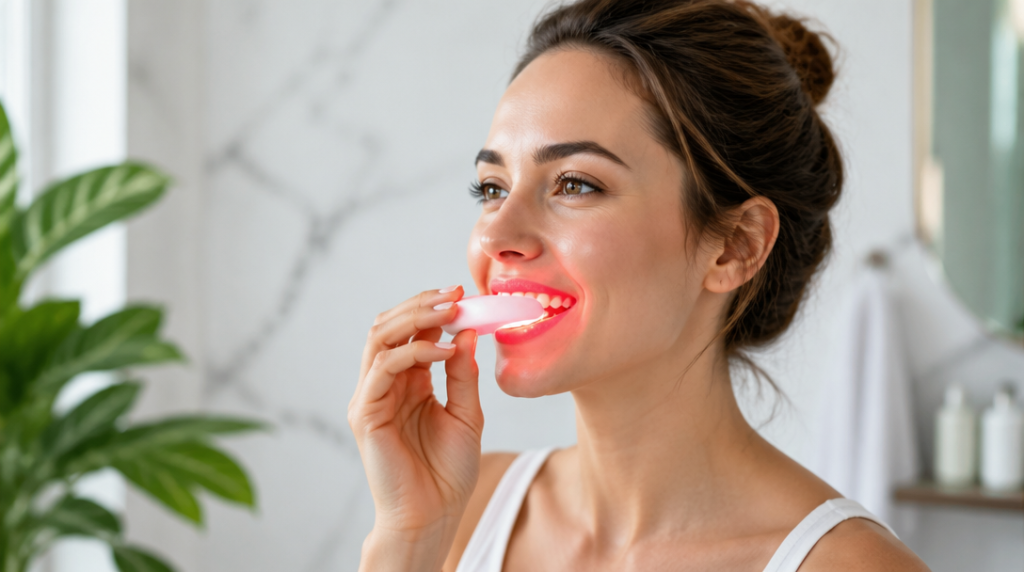
Photo by Jenn on Unsplash
In manufacturing consultations, companies frequently repurpose existing LED arrays without recalculating fluence for oral geometry. The result is devices that glow convincingly but deliver sub-therapeutic energy to the actual target—periodontal ligament fibers and junctional epithelium. The biology behind red light therapy is supported by peer-reviewed research. The engineering in many consumer devices often is not.
Clinical Evidence: Which Wavelengths and Dosages Show Results for Red Light Therapy Gums
The clinical data is mixed, and transparency about what exists versus what is still needed matters more than confident summaries.
ADA News has reported on research into at-home light therapy for periodontitis, citing approximately a 54% healing rate versus 22% without therapy in relevant studies. This moves beyond in-vitro fibroblast research to actual clinical endpoints that dentists track: bleeding on probing, pocket depth, and attachment levels. The therapeutic approach typically combines red wavelengths (around 630–700nm) with near-infrared (800–900nm), though exact parameters vary by study and device.
A published PMC study on photobiomodulation using LED light found that PBM significantly accelerated orthodontic tooth movement at both 1 and 4 weeks. Notably, the PBM group showed a lower incidence of gingival hypertrophy—21.4% versus 55.6% in the placebo group after 4 weeks. However, no statistically significant differences in plaque volume or sulcus bleeding were observed, indicating PBM’s effects on gingival tissue are specific rather than universal across all periodontal markers.
PubMed searches return 35 results for photobiomodulation as an adjunct to scaling and root planing in periodontitis, including a 2026 randomized controlled trial comparing high versus low intensity diode laser (PMID: 41723233) and a systematic review of PBM therapy for patients with type 2 diabetes complicated by chronic periodontitis (PMID: 41467963). These confirm active research interest but also reveal that dose-response curves specific to gingival tissue, head-to-head wavelength comparisons in randomized designs, and long-term maintenance data remain insufficient.
For buyers evaluating red light therapy gums claims, the wavelength question breaks down practically. Shorter red wavelengths (620–700nm) are effective for superficial gingival inflammation such as gingivitis, while longer near-infrared wavelengths (780–900nm) penetrate deeper for periodontal disease affecting bone and ligament structures. Most consumer devices use 630–660nm red LEDs because they are cost-effective and efficient. Near-infrared supplementation is rarer, more expensive, but theoretically more comprehensive for deeper periodontal structures.
Dosage parameters remain inconsistent across studies. Energy density (J/cm²), power density (mW/cm²), and treatment duration interact in ways that make simple “use for 10 minutes” instructions scientifically inadequate without knowing beam area and output. One clinical source recommends 16 minutes daily for 1–2 weeks during active inflammation (Apex Dental Iowa), but this protocol is specific to that practice’s device and cannot be generalized to all oral care devices.
Red Light Therapy Devices vs. Traditional Gum Care Products: Where Each Fits
Standard gum care operates on three established mechanisms: mechanical disruption (toothbrushes, floss, interdental cleaners), chemical antimicrobial action (chlorhexidine, essential oils, cetylpyridinium chloride), and host modulation (subantimicrobial doxycycline, topical NSAIDs). Photobiomodulation adds a fourth category: cellular bioenergetics and anti-inflammatory modulation.
Where light therapy fits depends on the patient profile. Mechanical and chemical methods address biofilm directly. PBM does not kill bacteria—it changes how tissue responds to bacterial challenge (Magnolia Ridge Dentistry, 2025). This means red light therapy for gums is not a replacement for plaque control but a potential amplifier of healing capacity. For patients with persistent inflammation despite adequate home care—common in smokers, diabetics, and those with genetic susceptibility—PBM offers a non-pharmaceutical adjunct.
The compliance angle carries weight. Chlorhexidine causes tooth staining and taste alteration, both well-documented in dental literature. Doxycycline requires a prescription. A home light device, used alongside existing routines, eliminates those barriers. But compliance cuts both ways—more on that below.
For B2B buyers, category positioning matters. Stocking PBM devices as “replacements” for floss or therapeutic rinses will generate returns and complaints. Positioning them as “professional-grade adjuncts for inflammation management”—with appropriate clinical framing—aligns better with actual evidence and realistic user expectations. NovaaLab notes that red light therapy “won’t completely regrow lost tissue” but may support gum health and slow recession, which is an honest framing to model.
What B2B Buyers Should Verify Before Stocking Red Light Oral Devices
Wholesale catalogs are filled with devices claiming “clinically proven” wavelengths. Almost none provide actual study citations, and when they do, the referenced study used a $50,000 medical laser in a dental office—not a consumer LED mouthpiece.
Demand the following from manufacturers:
- Verified optical output: Independent third-party testing of wavelength peak and full-width half-maximum (FWHM), not just “660nm” on a spec sheet. LED bins vary, and mitochondrial absorption curves are wavelength-specific.
- Fluence documentation for oral application: Energy density calculated at the gingival surface, accounting for the device’s actual beam profile in a mouth-shaped cavity. Flat-panel irradiance numbers are irrelevant for curved oral anatomy.
- Thermal safety data: Tissue temperature rise during recommended treatment duration. The oral mucosa is vascular and sensitive; even low-power devices can accumulate heat in enclosed trays.
- Predicate 510(k) correspondence: If marketed with therapeutic claims in the US, identify which cleared device the manufacturer claimed substantial equivalence to. This information is publicly accessible through the FDA’s 510(k) database.
- Clinical study using their specific device form factor: Not a wavelength used in another manufacturer’s laser study. Their LED array, their mouth tray design, their treatment protocol, in a published or registered trial.
Most manufacturers will fail on at least three of these criteria. That does not make them fraudulent—it makes the category immature. Early movers in B2B can capture market share, but inventory risk is elevated if regulatory scrutiny increases or if consumer efficacy expectations are not met.
Market trajectory supports cautious investment. Fortune Business Insights notes red light holds about 34% of the broader light therapy market, with a shift toward LED-based systems and portable formats. The demand is structural. The supply quality is variable.
FDA Clearance Classes and Safety Standards for At-Home Oral Red Light Therapy Gums Devices
Regulatory status is where marketing language gets deliberately imprecise.
The FDA’s guidance document “Photobiomodulation (PBM) Devices—Premarket Notification [510(k)] Submissions” (Docket No. FDA-2022-D-3116) covers Class II PBM medical devices regulated under product codes including 21 CFR 878.4810, 878.4850, 878.5400, and 890.5500. The guidance recommends non-clinical testing, clinical studies, and appropriate labeling for 510(k) submissions. Critically, FDA notes that some “general wellness” light-emitting products may fall outside this scope.
The practical distinction: a device marketed for “gum health” with specific therapeutic claims—reduces inflammation, improves periodontal parameters, serves as an adjunct to professional treatment—likely triggers medical device regulation and requires 510(k) clearance. A device marketed for “oral wellness,” “fresher feeling gums,” or “supports your oral care routine” may qualify as a general wellness product, exempt from 510(k) requirements. The same hardware, different words on the box.
For buyers, this creates liability exposure. Stocking a device that later receives FDA enforcement action for unapproved medical claims can generate downstream regulatory attention. Verify the manufacturer’s intended use statements and whether they hold actual 510(k) clearance—not just “FDA registered,” which means listed in a facility database and is not a review of safety or efficacy.
Radiation safety adds another layer. Laser products must comply with 21 CFR 1040.10 and 1040.11, covering performance standards, labeling, reporting, and import requirements. Most home oral devices use LEDs rather than laser diodes, avoiding laser product classification. Some devices incorporate laser diodes for targeted delivery. B2B buyers should confirm which technology they are stocking and its applicable regulatory pathway.
In Europe, Regulation (EU) 2017/745 on medical devices (MDR) governs any red light device marketed for a medical purpose. This requires conformity assessment, technical documentation, clinical evaluation, and CE marking before market placement. The MDR classification and conformity assessment rules in Annexes VIII through XI determine the specific certification pathway. “General wellness” positioning is harder to sustain under the MDR framework than under the FDA’s enforcement discretion approach.
For cross-border B2B operations, this regulatory asymmetry has practical consequences. A device legally sold as a wellness product in the US may require full medical device certification in the EU. Dual-market suppliers need dual compliance strategies, not interchangeable packaging with different stickers.
Consumer Use Patterns: Compliance Rates and Realistic Outcome Timelines
Even well-designed devices fail without consistent use. Photobiomodulation requires daily or near-daily application for weeks to months before periodontal parameters shift. The studies reporting positive outcomes at six-month evaluation timelines represent the realistic timeframe, not a conservative one.
Home light therapy devices across categories show steep compliance drop-off after 30 days. For oral devices specifically, the additional step beyond existing brushing and flossing routines creates cumulative behavioral load. Convenience helps, but “another thing to do” friction is real.
Realistic outcome timelines for B2B buyers to communicate: gingival inflammation reduction may become perceptible to consumers—less bleeding during brushing, reduced tenderness—at 4–8 weeks of consistent use. Measurable periodontal parameter changes (probing depth, clinical attachment level) require professional measurement at 3–6 month intervals. These are not rapid results, and positioning them as such generates negative reviews and returns.
The ADA News coverage referencing a 54% healing rate versus 22% without therapy suggests genuine clinical potential. But that study context—likely involving professional supervision or clinic-initiated protocols—differs from unsupervised consumer use. The translation from clinical trial to living room is imperfect.
For retail positioning, consider bundling with compliance supports: app-based reminders, progress tracking, or integration with existing dental health routines rather than additive steps. Smart sensors and app-connected light therapy features address compliance directly and represent the direction consumer devices are heading.
The Bottom Line for B2B Buyers
Red light therapy for gums has a legitimate biological basis and growing clinical support as an adjunct to standard periodontal care. It does not replace brushing, flossing, or professional treatment. The devices currently available vary enormously in engineering quality, regulatory standing, and clinical substantiation. Buyers who verify optical output, fluence calculations, thermal safety, regulatory clearance, and device-specific clinical data will separate credible products from convincing packaging. The market is growing. The science is real but still maturing. Stock accordingly.
References
- ADA News. “Dental research moves toward at-home light therapy for periodontitis.” https://adanews.ada.org
- ST Smiles. “Red Light Therapy for Gum Health.” https://stsmiles.com.au
- NovaaLab. “Red Light Therapy for Gum Recession.” https://novaalab.com
- Magnolia Ridge Dentistry. “Red Light Therapy for Gum Health.” https://magnoliaridgedentistry.com
- Apex Dental Iowa. “Red Light Therapy for Gum Disease.” https://apexdentaliowa.com
- PMC. “Photobiomodulation using LED light and gingival hypertrophy outcomes.” https://pubmed.ncbi.nlm.nih.gov/
- FDA. “Photobiomodulation (PBM) Devices—Premarket Notification [510(k)] Submissions.” Docket No. FDA-2022-D-3116. https://www.fda.gov
- Regulation (EU) 2017/745 of the European Parliament and of the Council on medical devices. https://eur-lex.europa.eu
Disclaimer
This article is for informational purposes only. LLRNCARE makes no representations or warranties about the completeness, accuracy, or reliability of the information. Any reliance is at your own risk.
For professional dental advice, consult a qualified dental professional. For regulatory compliance, consult legal experts.
—