
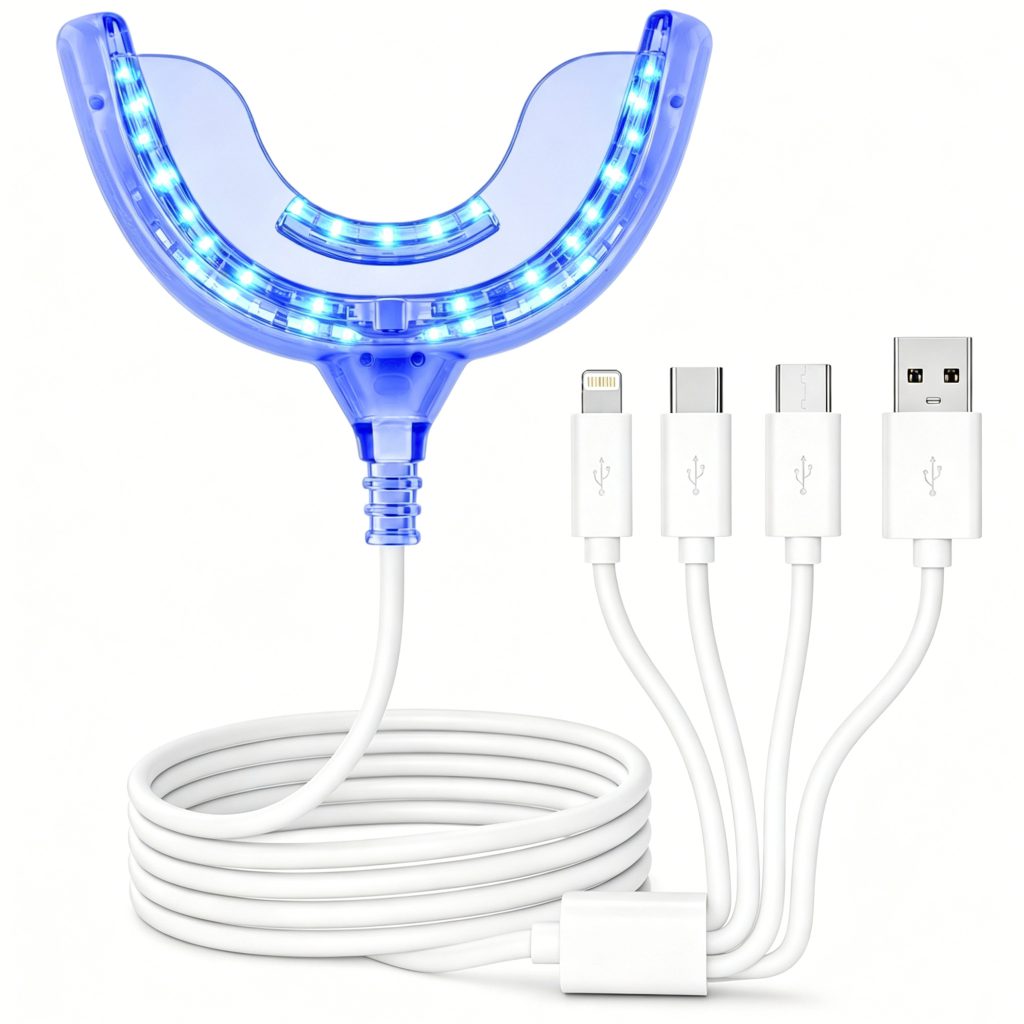
LED Teeth Whitening Devices: Clinical Evidence vs Marketing Hype
What LED Teeth Whitening Devices Actually Do at the Molecular Level The light from LED teeth whitening devices does not bleach enamel on its own. The chemistry is driven by hydrogen peroxide or carbamide peroxide gel. The LED’s role—when it works at all—is to accelerate the breakdown of that peroxide into reactive oxygen species that … Read more
What LED Teeth Whitening Devices Actually Do at the Molecular Level
The light from LED teeth whitening devices does not bleach enamel on its own. The chemistry is driven by hydrogen peroxide or carbamide peroxide gel. The LED’s role—when it works at all—is to accelerate the breakdown of that peroxide into reactive oxygen species that attack chromophores embedded in the dentin and enamel surface.
A 2024 clinical comparison published in Lasers in Medical Science (PMID: 39060473) examined violet and blue LED photoactivation with different hydrogen peroxide concentrations. The data reinforces what photochemistry predicts: light-activated protocols paired with peroxide gels produced measurable color change, while the light component alone contributed far less. The peroxide does the heavy lifting; the LED, if properly matched to a photosensitizer or photo-initiator in the gel formulation, may speed the reaction kinetics.
Blue light (roughly 450–490 nm) excites photo-initiators that some manufacturers add to whitening gels. Violet light pushes into the 380–420 nm range, where certain formulations show stronger absorption characteristics. Red and near-infrared wavelengths serve entirely different purposes—more on that below. The takeaway for buyers: without a gel chemistry engineered for your specific LED wavelength, you are selling a very expensive mouth lamp.
Contract manufacturers frequently get this pairing wrong. They source 470 nm blue arrays from cosmetic skincare lines, drop them into mouth trays, and call it a whitening system. The gel chemistry was never designed for that excitation spectrum. The result is a placebo with a power cord.

Clinical Studies That Support LED Teeth Whitening Devices—and Those That Don’t
The evidence base is mixed, and there is no reason to pretend otherwise.
The 2024 Lasers in Medical Science study (PMID: 39060473) compared whitening efficacy and tooth sensitivity across different hydrogen peroxide concentrations photoactivated with violet or blue LEDs. Results indicated that LED-assisted protocols with appropriate peroxide concentrations produced clinically meaningful color change with manageable sensitivity. This data point matters for B2B buyers because it suggests device-plus-gel systems can deliver defensible outcomes when the protocol is properly designed.
An earlier 2012 study on LED-assisted in-office bleaching (PMC3466022) found a noticeable immediate whitening effect. However, the overall color improvement was modest, and tooth and gingival sensitivity remained low—clinically relevant for patient tolerance, but not the basis for aggressive marketing claims. You cannot build a product story on “patients noticed something right after the light switched off.”
What does the aggregate evidence tell us? LED may help as an adjunct, but the whitening gel does most of the clinical work. For procurement teams, the practical implication is straightforward: demand wavelength-specific clinical validation for the exact device-gel pairing you intend to source. A study on 410 nm violet with one manufacturer’s gel does not transfer to your 465 nm blue device with a different formulation. The industry gets this wrong routinely.
Wavelength Matters: Why Blue, Violet, and Red LED Teeth Whitening Devices Deliver Different Results
Not all LEDs whiten. Some are not designed to.
Blue light (approximately 450–470 nm in most commercial devices) targets photo-initiators in whitening gels. When the gel contains appropriate chromophores—often proprietary to specific manufacturers—blue excitation accelerates peroxide decomposition. Without those chromophores, blue light warms the tissue slightly and does little else. That warming can increase sensitivity in some patients.
Violet LED, specifically the 380–420 nm range, sits at a different absorption region for several whitening activators. The 2024 clinical data showed violet photoactivation producing effective results when paired with appropriate peroxide concentrations. Some researchers have also investigated violet LED’s interaction with fluoride-containing carbamide peroxide gels on compromised enamel surfaces (DOI: 10.1016/j.pdpdt.2023.103568), indicating the wavelength has genuine photochemical utility when matched correctly.
Red and near-infrared LEDs (620–750 nm and above) are not whitening technologies in the oxidative sense. Red light is studied for anti-inflammatory effects, collagen stimulation in soft tissue, and sometimes as an adjunct to reduce post-whitening sensitivity. Some premium devices now combine blue or violet diodes for bleaching with red for desensitization in the same treatment session. This is smart product design only if the claims are cleanly separated. Red does not bleach. Selling it as a whitening wavelength is misleading.
Market research from The Business Research Company highlights “innovative wavelength technologies” as a trend. Skepticism serves buyers well here. “Innovative wavelength” could mean rigorous photochemical optimization—or a marketing team that picked a color performing well in social media ads. Demand spectral output data from suppliers. A reputable manufacturer will provide peak wavelength, full-width at half-maximum (FWHM), and irradiance at the tooth surface in mW/cm². If they refuse, find another supplier.
How FDA Classification Affects What You Can Legally Sell
Regulatory framing determines your labeling, your claims, and your liability exposure.
In the United States, the FDA classifies certain light sources used in tooth bleaching as Class I or Class II medical devices under 21 CFR Part 872 (dental devices). The specific classification depends on the device’s intended use, design characteristics, and whether it incorporates features that elevate its risk profile. Class I devices are subject to general controls, which sounds permissive but still restricts the claims you can make. You cannot state “whitens teeth” without substantiation, and you cannot imply clinical efficacy your data does not support.
Health Canada’s Medical Devices Regulations (SOR/98-282) establish a parallel licensing regime where classification depends on intended use and risk level. A light source marketed with whitening claims may trigger medical device obligations. Australia’s Therapeutic Goods (Medical Devices) Regulations 2002 operate on similar principles—classification, essential principles compliance, and ARTG listing. For B2B buyers sourcing white-label or OEM LED teeth whitening devices, the regulatory pathway in your target market must be mapped before production begins, not after your first container clears customs.
Some suppliers sell LED mouthpieces as “cosmetic accessories” or “wellness devices” to sidestep medical device scrutiny. This works until it doesn’t. If your marketing mentions tooth color change, stain removal, or bleaching, regulators in most jurisdictions can reclassify the product. In the European Union, products making whitening claims may fall under the Cosmetics Regulation (EC) No 1223/2009—which caps hydrogen peroxide concentration for consumer products—or under the Medical Device Regulation (EU) 2017/745 depending on the device’s intended purpose. North American buyers exporting to Europe need to understand both frameworks.
My recommendation: demand the supplier’s FDA establishment registration, device listing, and any clearance or classification determination documentation. For EU-bound products, ask for the relevant conformity assessment documentation and technical file. If they hedge, they are either uninformed or evasive. Neither builds a reliable supply chain. For deeper context on dental care product sourcing, regulatory due diligence is non-negotiable.
Key Specs B2B Buyers Should Demand From LED Teeth Whitening Device Suppliers
Specifications separate professional-grade devices from low-cost opportunism. Here is what belongs in your procurement checklist.
Spectral data: Peak wavelength ±5 nm, FWHM, and irradiance at the occlusal plane. Not “blue light.” Not “dental grade.” Numbers. The 2024 clinical evidence was generated under specific wavelength conditions; your supplier should know exactly where their diodes sit on the spectrum.
Thermal management: LED efficiency degrades with junction temperature. A device running at 60°C loses output and shifts wavelength. Ask for thermal testing data, not just “low heat design” marketing copy.
Cycle life and output degradation: How many hours until irradiance drops 20%? Diode arrays cheap enough for impulse-buy pricing often degrade in hundreds of hours, not thousands. This directly affects your warranty exposure and customer satisfaction.
Gel compatibility documentation: If the device ships with gel, demand photochemical validation for that specific pairing. If sold without gel, your labeling must not imply efficacy with untested products. The clinical literature’s consistent finding—that combination therapy outperforms light alone—validates good pairings and exposes bad ones equally.
Electrical safety: IEC 60601-1 or equivalent for clinical-use devices; UL/CSA certification for consumer units. Battery chemistry documentation for lithium-powered portables, including UN38.3 transportation testing. The LED teeth whitening devices market is projected to grow significantly through the end of this decade. That growth will attract cut-rate suppliers with questionable safety documentation.
Procurement teams sometimes get dazzled by MOQ flexibility and fast tooling. Six months later they are managing returns, regulatory inquiries, and complaints from dental professionals. The specifications you demand upfront are cheaper than the reputation damage that follows. For more on evaluating oral care product quality, technical due diligence is the first line of defense.
How Leading Brands Position Their LED Teeth Whitening Devices
Established brands handle the evidence gap with varying degrees of care.
GLO Science, founded by a practicing dentist, built its positioning around controlled warming plus light in a closed-system mouthpiece. Their marketing emphasizes dental-office origin and professional endorsement. The device is sold as part of a complete system with their formulated gel—not as a standalone light. This mirrors the structure of positive clinical findings: device plus gel, combination protocol, managed expectations.
Philips, within its broader oral healthcare portfolio, has historically been conservative with whitening claims. Their approach leans on brand trust and dental professional channel relationships rather than dramatic before-and-after promises. When light elements appear in their product lines, they typically sit within a broader oral care ecosystem—connected apps, complementary products, subscription refills. The light becomes a feature within a system, not the headline.
Both approaches illustrate a positioning reality: in a market where clinical evidence remains mixed, the brands building long-term credibility anchor on system integrity, professional endorsement, and measured claims. The brands that stumble tend to lead with “clinically proven” banners while burying the actual study limitations in inaccessible fine print.
For B2B buyers evaluating white-label or competitive positioning: the market is being pulled by at-home cosmetic treatment demand and consumer interest in teeth whitening aesthetics. But the brands earning shelf space and dentist recommendations are those that respect what the evidence actually supports. That leadership position is defensible only if the products perform to specification.
Evaluating LED Device Durability, Warranty, and Real-World Failure Rates
The global teeth whitening market was estimated at approximately USD 7.5 billion in 2023, with projections reaching toward USD 10.6 billion by 2030. LED teeth whitening devices represent a growth segment within that. Growth attracts manufacturers optimizing for unit cost, not longevity.
LED degradation is not linear—it accelerates. A diode rated for 10,000 hours at 25°C may fail at 2,000 hours inside a warm, moist oral environment where galvanic corrosion attacks electrical contacts exposed to saliva. The mouthpiece materials—typically medical-grade silicones or TPU—undergo repeated flexural stress and chemical exposure from whitening gels. USB port seals can fail within months, turning “water-resistant” devices into paperweights.
Warranty terms reveal supplier confidence. A one-year limited warranty on a consumer device used weekly suggests roughly 50–60 cycles of expected life. That is not ambitious. Professional devices in dental offices see heavier use; their warranties should reflect commercial-duty design. Ask for mean time between failures (MTBF) data. If the supplier has none, they have not tested adequately.
Battery systems in portable LED teeth whitening devices introduce additional failure modes. Lithium polymer cells degrade with charge cycles and temperature exposure. Swollen batteries in mouthpieces are a safety hazard, not just a warranty claim. The supplier should provide UN38.3 transportation testing documentation and cell manufacturer certification.
Real-world failure analysis is scarce in published literature. Manufacturers do not volunteer this data. Your best due diligence: request reference accounts from existing B2B customers, particularly those with 12 or more months in market. Ask specifically about return rates, dominant failure modes, and how responsive the supplier was when problems emerged. A supplier who can point you to satisfied distribution partners with real field data is worth more than one offering the lowest FOB price with no track record.
References
- Clinical comparison of whitening efficacy and tooth sensitivity of different concentrations of hydrogen peroxide photoactivated with violet or blue LEDs. Lasers in Medical Science, 2024. PMID: 39060473. https://pubmed.ncbi.nlm.nih.gov/39060473/
- Influence of violet LED and fluoride-containing carbamide peroxide bleaching gels on early-stage eroded/abraded teeth. Photodiagnosis and Photodynamic Therapy, 2023. DOI: 10.1016/j.pdpdt.2023.103568. https://doi.org/10.1016/j.pdpdt.2023.103568
- LED-assisted in-office bleaching study, 2012. PMC3466022. https://www.ncbi.nlm.nih.gov/pmc/articles/PMC3466022/
- Healthline: LED Teeth Whitening. https://www.healthline.com/health/dental-and-oral-health/led-teeth-whitening
- FDA Medical Device Classification Database — 21 CFR Part 872. https://www.accessdata.fda.gov/scripts/cdrh/cfdocs/cfcfr/CFRSearch.cfm?CFRPart=872
- EU Cosmetics Regulation (EC) No 1223/2009. https://eur-lex.europa.eu/legal-content/EN/TXT/?uri=CELEX:32009R1223
Disclaimer
This article is for informational purposes only. LLRNCARE makes no representations or warranties about the completeness, accuracy, or reliability of the information. Any reliance is at your own risk.
For professional dental advice, consult a qualified dental professional. For regulatory compliance, consult legal experts.