
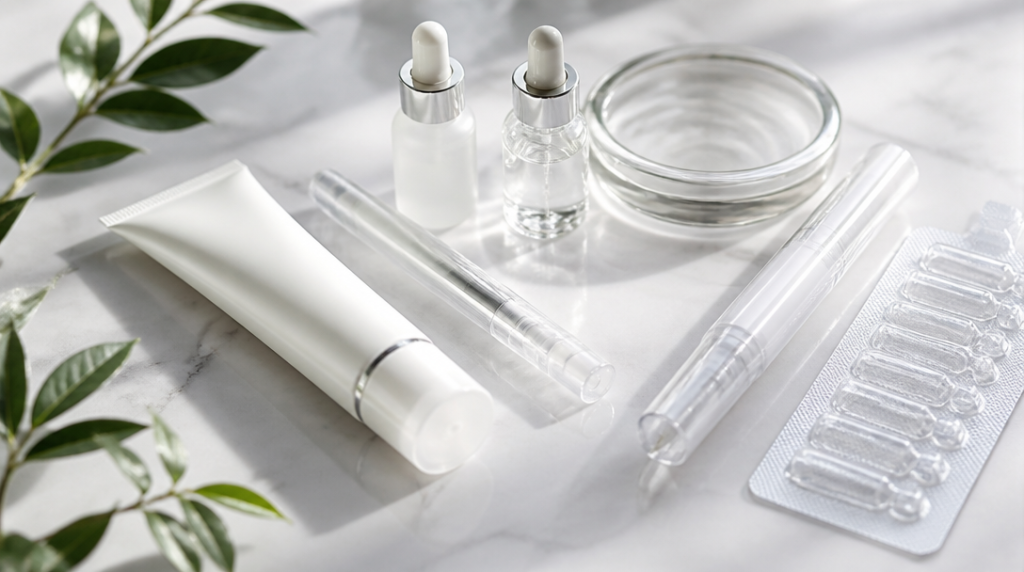
PAP vs Peroxide Whitening: What B2B Buyers Order Now
Why Sensitivity-Free Whitening Is Reshaping Professional Purchase Orders Walk the floor at any dental trade show this year and the shift is visible. Booths that led with peroxide percentages three years ago now foreground “zero sensitivity” and “enamel-safe” claims. Reorder patterns tell a similar story: clinics that once stocked 22% carbamide peroxide gels as their … Read more
Why Sensitivity-Free Whitening Is Reshaping Professional Purchase Orders
Walk the floor at any dental trade show this year and the shift is visible. Booths that led with peroxide percentages three years ago now foreground “zero sensitivity” and “enamel-safe” claims. Reorder patterns tell a similar story: clinics that once stocked 22% carbamide peroxide gels as their go-to are now splitting SKUs between traditional peroxide and phthalimidoperoxycaproic acid (PAP) formulations.
This is not a simple replacement story. Peroxide still moves volume. What is changing is the structure of professional purchase orders. Buyers are building dual-formula portfolios, and that decision carries implications for compliance documentation, cold-chain logistics, shelf-life planning, and margin math that consumer-facing coverage rarely touches.
A 2024 in vitro study published in the Journal of Functional Biomaterials (Akaltan et al., “Phthalimidoperoxycaproic Acid (PAP) Versus Peroxides and Impact on Dental Enamel After Whitening Treatment”) provides B2B buyers with a useful head-to-head data point: PAP produced measurable whitening with less enamel surface change and less microhardness reduction than peroxide comparators under the study’s controlled conditions. That finding — efficacy combined with relative enamel preservation — is what converts a clinical curiosity into a stockable SKU for clinics and spas serving sensitivity-prone patients.
But the procurement reality is messier than the marketing. PAP formulations carry their own stability concerns, their own regulatory gray zones, and their own reorder dynamics. This article walks through what actually matters when you are writing purchase orders, not when you are reading press releases.
PAP and Peroxide Mechanisms: What Buyers Need to Know About Efficacy Claims
Both chemistries oxidize stain molecules. The difference is in what else they oxidize along the way.
Hydrogen peroxide and carbamide peroxide generate free radicals that attack chromophores in enamel and dentin. That reactivity is the source of their whitening power — and their side effects. A 2023 study on OTC whitening products found that hydrogen peroxide showed the strongest color change among tested formulations; PAP also whitened effectively, though it produced less shade change than hydrogen peroxide in that particular experimental setup. Peroxide retains the efficacy edge in direct comparison under controlled conditions, though real-world compliance and patient tolerance add variables that lab studies do not capture.
PAP works through a different oxidative pathway. The phthalimide group targets stain molecules with what researchers describe as more selective reactivity, producing less collateral disruption to enamel mineral structure. A 2022 overview in the British Dental Journal discussed PAP+ as a non-peroxide whitening approach designed to deliver whitening results while reducing the enamel and mineral effects commonly associated with peroxide. For buyers, that translates to a positioning claim: “whitening with fewer structural trade-offs.” Whether that claim holds across all formulations and concentrations is a question that current evidence does not fully resolve.
Color stability deserves particular attention. A 2025 pilot randomized clinical study published in BMC Oral Health (Comparative evaluation of LED- and diode laser-assisted in-office tooth whitening) showed immediate color improvement with minimal adverse effects when PAP was used with light activation, but color stability weakened over subsequent weeks. That matters for downstream claims. A peroxide system may deliver more durable results; a PAP system may need more frequent reapplication or maintenance-product attachment to sustain patient satisfaction.
What to check on supplier spec sheets:
- Whether efficacy data is reported at 7 days, 14 days, or longer intervals — the timepoint chosen dramatically affects how a formula looks on paper
- Whether shade-change metrics use Vita Classical, Vita 3D-Master, or spectrophotometer readings (cross-study comparison is unreliable without standardized measurement)
- Whether “sensitivity-free” claims are backed by patient-reported outcome measures or simply by the absence of reported adverse events in a small sample
Suppliers tend to select the timepoint that flatters their chemistry. A PAP formulation may look better at day seven than at day ninety; peroxide may look stronger in a lab study than in a real-world compliance scenario where patients skip sessions. The buyer’s job is to match the chemistry to the patient profile and the clinical follow-up model.
Regulatory Status Across Key Markets: Concentration Caps and Labeling Differences
This is where purchase orders get held up at customs — or pulled from shelves.
Peroxide whitening lives under strict concentration ceilings in the European Union. Commission Directive 2011/84/EU, amending Council Directive 76/768/EEC, restricts tooth whitening products containing or releasing more than 0.1% but not more than 6% hydrogen peroxide to use by or under the direct supervision of a dental practitioner. Products above 6% hydrogen peroxide are not permitted for cosmetic tooth whitening. Consumer-use products must stay at or below 0.1% hydrogen peroxide equivalent. Regulation (EC) No 1223/2009 on cosmetic products provides the overarching enforcement framework for labeling, responsible person requirements, and product information files.
For North American buyers, the regulatory landscape is different and less uniform. In the United States, the FDA has not established a specific concentration threshold that cleanly separates cosmetic from drug classification for whitening products; classification depends on intended use, claims, and formulation. State dental board rules add another layer of variability. In Canada, Health Canada’s current guidance treats peroxide-containing whitening products under cosmetic regulatory requirements, with specific safety evidence and pH documentation required. Buyers sourcing for the Canadian market should review Health Canada’s most recent guidance documents rather than relying on generalizations about drug or NHP classification.
PAP’s regulatory position is where sourcing gets nuanced. Because PAP is not hydrogen peroxide or a peroxide-releasing compound, it generally falls outside the EU’s peroxide-specific restrictions — provided the product makes cosmetic whitening claims and complies with each market’s general cosmetic safety rules. That proviso carries weight. A PAP product marketed with therapeutic claims — treating dental disease, modifying tooth structure — risks reclassification under medical device or pharmaceutical frameworks depending on the jurisdiction. The compliance question for buyers is usually not “does it whiten?” but “is this specific formula, with this claim set, sold through this channel, lawful in the target market?”
Practical sourcing steps:
- Request the supplier’s regulatory classification opinion for each target market — not just a generic “CE marked” or “FDA registered” statement, but a documented assessment addressing the specific product and its claims
- Verify that labeling matches the classification: professional-use-only symbols where required, no therapeutic claims on cosmetic-classified SKUs
- For EU distribution, confirm the responsible person is named and the product information file covers PAP safety data specifically
- Check whether your product liability insurance covers non-peroxide whitening chemistries — some policies are written around peroxide-specific risk profiles
The channel advantage is real but narrow. A PAP product can potentially be sold through retail channels in the EU that would be restricted to dental professionals at peroxide concentrations above 0.1%. But mislabel it, overclaim it, or distribute it through a non-compliant channel and that advantage dissolves into enforcement risk.
Shelf Stability, Cold-Chain Risk, and Inventory Cost Compared
Peroxide degrades. Temperature accelerates degradation. Every buyer knows this; not every buyer accounts for it in their landed-cost calculation.
Carbamide peroxide is more stable than hydrogen peroxide but still requires controlled storage — manufacturer specifications typically call for cool, light-protected conditions. Cold-chain or temperature-controlled shipping adds meaningful per-unit cost depending on volume and shipping lane. For a distributor holding ninety days of inventory, those added logistics costs become a real margin consideration.
PAP formulations present a different stability profile. The phthalimide-peracid bond is sensitive to moisture and pH, not just temperature. PAP products are often packaged in dual-chamber systems or with desiccant-heavy primary packaging to protect the active ingredient — packaging costs that get passed through the supply chain. However, some suppliers specify a wider acceptable storage temperature window for PAP than for peroxide, which can reduce cold-chain dependency for regional distribution.
The inventory math diverges further. Peroxide products carry expiration risk that demands strict first-in-first-out discipline and often leads to quarterly write-downs on slow-moving stock. PAP products may offer longer shelf lives than unstabilized peroxide gels, but buyers should verify this on the certificate of analysis for the specific SKU formulation — not on the marketing brochure. Some PAP formulations use stabilizing co-ingredients that introduce their own compatibility and stability concerns.
What to audit on supplier factory visits:
- Whether stability testing follows recognized protocols (such as ICH Q1A guidelines) covering both accelerated and long-term conditions
- Whether real-time stability data exists for the specific SKU formulation, not just the bulk active ingredient
- Packaging integrity testing under temperature cycling — particularly relevant for products crossing climate zones during transit
- Whether the supplier holds inventory themselves and absorbs expiry risk, or pushes that cost entirely to the buyer
Temperature-controlled logistics can meaningfully swing total landed cost for peroxide products. For a clinic buying direct in small quantities, the impact may be marginal. For a distributor moving container quantities across borders, it becomes a line item that separates viable SKUs from margin drains.
Sensitivity Complaint Rates: What Clinics and Spas Report After Switching to PAP
The reorder data starts to diverge along complaint-type lines. The Akaltan et al. 2024 study’s finding — less enamel surface change, less microhardness reduction — aligns with what clinics report in practice: fewer post-treatment sensitivity calls, less need for desensitizing adjuncts, and higher completion rates for multi-session whitening protocols.
But “fewer” is not “zero.” PAP can still cause soft-tissue irritation, especially at higher concentrations or with poor isolation technique. The 2025 BMC Oral Health pilot study noted minimal adverse effects with laser-assisted PAP, which is encouraging — but laser assistance is not the standard configuration for take-home kits or spa-channel products that most B2B buyers are sourcing.
For spa operators without dental licensure, sensitivity complaints carry amplified risk. A patient who experiences sensitivity spikes with peroxide may blame the product; with PAP, the same operator may face complaints about efficacy instead — results that do not meet expectations set by “professional-grade whitening” marketing. The complaint profile shifts rather than disappears.
What distributors should track:
- Return and replacement rates by formula type, normalized for volume sold
- Customer service inquiry categorization: sensitivity, efficacy, packaging, application instructions
- Correlation between complaint type and patient screening protocols — was sensitivity history taken before treatment?
- Whether clinics using PAP report higher attachment sales of maintenance products, which could represent a compensatory revenue stream offsetting the durability gap noted in clinical data
Patient expectation management matters as much as chemistry selection. A PAP patient expecting “no sensitivity, identical results” will be disappointed if shade change fades faster. A peroxide patient counseled on transient sensitivity and longer-lasting shade improvement may accept that trade-off willingly. Your SKU mix should support both clinical conversations.
Margin and Reorder Analysis: How Each Formula Performs at Retail and In-Chair
Peroxide products have mature, well-benchmarked pricing. PAP products currently command a wholesale premium — often substantial — justified by the sensitivity positioning and regulatory channel flexibility. Whether that premium holds depends on whether your end customers can extract proportional value from those attributes.
In-chair professional use: Peroxide at professionally supervised concentrations (up to 6% hydrogen peroxide equivalent for cosmetic use in the EU; higher concentrations require separate regulatory pathways) delivers results in fewer sessions. That translates to chair-time efficiency, which is the dominant cost driver in a dental clinic. PAP may require additional sessions or adjunctive light activation to approach comparable shade change, based on the 2023 and 2025 study findings discussed above. Per-session revenue may be similar; total treatment revenue and patient throughput can differ.
Retail and take-home: PAP’s regulatory flexibility opens channels that peroxide cannot easily access. A hydrogen peroxide strip above 0.1% is professional-only in the EU; a PAP strip making equivalent cosmetic whitening claims can potentially reach retail shelves. That channel expansion can justify the wholesale premium when distribution reaches pharmacies, beauty retailers, or direct-to-consumer platforms. Early 2026 category data from multiple sourcing platforms shows PAP+ non-peroxide kits among the prioritized SKUs for distributors and private-label brand owners — driven precisely by this channel arbitrage potential.
Reorder patterns reveal another split. Peroxide products tend toward predictable replenishment cycles: gel syringes and maintenance strips on quarterly schedules. PAP products, given the color stability limitations documented in clinical research, may drive faster reorder cycles for maintenance products — or higher churn if patients perceive shade regression. The 2025 study’s finding on weakening color stability is not just a clinical data point; it is a customer lifetime value input that should inform your forecasting models.
Margin structure checklist for buyers:
- Does the supplier offer tiered pricing that rewards dual-formula stocking?
- Are marketing development funds available for one chemistry but not the other?
- What is the minimum order quantity gap between peroxide and PAP SKUs — some suppliers require significantly higher volume commitments for PAP to reach competitive pricing
- Does the supplier provide patient education materials that support premium positioning, reducing your own content development costs?
Market signals from early 2026 indicate that PAP+ and peroxide-free formulations are among the fastest-growing segments, while traditional peroxide-heavy strips face increasing competition. The strip format itself remains commercially viable — whitening strips as a category continue to generate strong revenue — but the chemistry within the format is shifting. Buyers carrying peroxide-only strip inventory should be evaluating whether repositioning or planned clearance is warranted.
Building a Dual-Formula Sourcing Strategy
The most resilient procurement approach for 2026 and beyond is not choosing one chemistry over the other — it is building a portfolio that serves both the sensitivity-averse patient segment and the results-driven segment, while managing the operational complexity that comes with stocking two fundamentally different formulation types.
A practical dual-formula sourcing framework addresses four dimensions:
Patient segmentation: Peroxide remains the stronger choice for patients seeking maximum shade change who can tolerate transient sensitivity and commit to completing the prescribed protocol. PAP serves patients with documented sensitivity history, those unwilling to accept any discomfort, and those reached through retail channels where peroxide concentrations are restricted. The split is not arbitrary — it should be driven by your clinic or distribution channel’s actual patient demographic data.
Supplier qualification: Running two chemistries means qualifying two supply chains. Evaluate whether a single supplier can provide both formulation types with adequate quality systems, or whether separate specialist suppliers offer better pricing and formulation expertise. Consolidation simplifies logistics but may compromise formulation quality; diversification adds vendor management overhead but mitigates single-source risk.
Inventory planning: Different degradation profiles mean different safety stock calculations. Peroxide SKUs need tighter expiry management and potentially temperature-controlled storage. PAP SKUs need moisture protection and may carry longer shelf life but also have less established demand baselines for accurate forecasting. Model both product lines separately before combining them in your warehouse plan.
Claims and training alignment: Every SKU in your portfolio requires that your sales team, clinical staff, or retail partners can accurately communicate the benefits and limitations of each chemistry. Overselling PAP as “just as effective but with zero sensitivity” creates returns and reputational damage. Underselling peroxide by failing to address sensitivity management creates missed treatment starts. Invest in training materials that present honest, evidence-based comparisons.
The whitening category is not contracting — it is fragmenting. Buyers who treat PAP and peroxide as competing technologies will be forced to pick a side and accept the limitations. Buyers who treat them as complementary tools serving different clinical needs and regulatory environments will capture a broader share of the market while managing risk more effectively.
References
- Akaltan, F. et al. (2024). “Phthalimidoperoxycaproic Acid (PAP) Versus Peroxides and Impact on Dental Enamel After Whitening Treatment: An In Vitro Study.” Journal of Functional Biomaterials, 17(2), 104. https://doi.org/10.3390/jfb17020104
- “Comparative evaluation of LED- and diode laser-assisted in-office tooth whitening: a pilot randomized clinical study.” (2025). BMC Oral Health. https://doi.org/10.1186/s12903-026-09268-5
- Commission Directive 2011/84/EU amending Council Directive 76/768/EEC on cosmetic products. https://eur-lex.europa.eu/legal-content/EN/TXT/?uri=CELEX%3A32011L0084
- Regulation (EC) No 1223/2009 of the European Parliament and of the Council on cosmetic products. https://eur-lex.europa.eu/legal-content/EN/TXT/?uri=CELEX%3A32009R1223
- Health Canada — Guidance on tooth whitening products. https://www.canada.ca/en/health-canada/services/consumer-product-safety/cosmetics/regulatory-information.html
Disclaimer
This article is for informational purposes only. LLRNCARE makes no representations or warranties about the completeness, accuracy, or reliability of the information. Any reliance is at your own risk.
For professional dental advice, consult a qualified dental professional.