
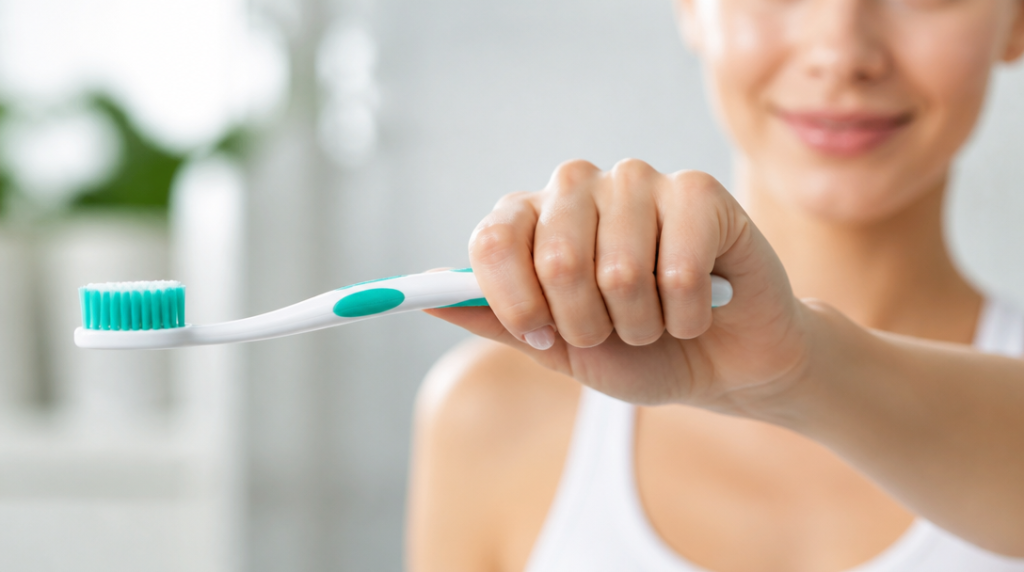
How Your Toothbrush Grip Pressure Strips Whitening Away
You finally got the results. The strips, the trays, the careful timing. Your teeth look brighter. Then two weeks later, that dull yellow seems to creep back in. Most people blame the coffee, the wine, the whitening product itself. The real culprit might be happening twice a day in your bathroom, and you cannot even … Read more
You finally got the results. The strips, the trays, the careful timing. Your teeth look brighter. Then two weeks later, that dull yellow seems to creep back in. Most people blame the coffee, the wine, the whitening product itself. The real culprit might be happening twice a day in your bathroom, and you cannot even feel it.
The force you grip your toothbrush with—translated through bristles onto enamel that has just been chemically altered by whitening—can undo your results faster than many lifestyle factors. This is not about brushing technique in the abstract. It is about measurable grams of force against a surface that is temporarily more porous, more vulnerable, and more expensive to fix than you think.
The 150-Gram Threshold: How Much Force Damages Whitened Enamel
Dentists generally recommend brushing with light pressure—roughly the weight of an orange, or about 150 grams of force. Go beyond that and you are not cleaning better; you are wearing your teeth down. The problem is that most adults brush with well over 300 grams without realizing it. Research consistently shows that roughly half of people apply more than twice the recommended force. Your fingers are poor pressure gauges.
Whitening compounds, particularly peroxide-based systems, work by opening the enamel’s pore structure to reach deeper stains. This is not damage in the clinical sense; it is the intended mechanism. But that same porous state leaves the enamel surface temporarily softer and more susceptible to mechanical wear. Researchers have documented reductions in enamel microhardness following peroxide exposure, with recovery depending on saliva remineralization over the days that follow. Apply heavy brushing force to that compromised surface and you risk accelerating enamel wear rather than simply removing stain.
The grams matter because enamel does not regenerate. What you wear away in those first days after whitening is gone permanently. And here is where it connects to color: thinner enamel reveals more of the yellowish dentin beneath. Your whitening result does not “wash off.” You may be gradually brushing through the very optical effect you worked to achieve.
I have talked to people who went through three rounds of professional whitening in a year, each time frustrated by rapid rebound. When they finally switched to pressure-controlled brushing, the fourth round lasted months longer. The product was not the variable. Their grip was.
Why Whitened Teeth Are More Susceptible to Abrasion Than Untreated Teeth
Peroxide whitening creates a temporary state where the enamel surface loses some mineral content during the oxidation process, then slowly rehardens through saliva-driven remineralization. Published research has documented increased surface roughness in enamel following whitening treatments, with recovery timelines varying from roughly 48 hours to several days depending on the concentration used and individual saliva composition. Brush aggressively during this window and you risk interrupting the recovery while physically abrading the compromised layer.
Rougher surfaces also catch stain faster, creating a compounding problem: you lose the bright layer and create a more stain-prone texture beneath it.
Most whitening instructions tell you to avoid dark foods and drinks post-treatment. Very few mention the mechanical abrasion risk from brushing. That gap in guidance can cost people their results. You can avoid coffee for three days and still undermine everything with a heavy-handed bedtime brush.
Gingival recession compounds the issue. Excessive pressure does not just wear enamel; over time, it pushes back gum tissue. Exposed root surfaces are naturally yellower, softer, and generally do not respond to peroxide whitening. The result can be a two-tone appearance: brighter crown, yellow root, and a visible line where your gum used to be.
Some dentists now recommend treating freshly whitened teeth the way you would treat a healing wound. Gentle cleansing, no scrubbing, protective measures. The analogy holds because the biology is similar: a disrupted surface, a vulnerable window, and a risk of lasting change if mishandled.
Understanding enamel health and everyday habits that protect it
The Pencil Grip vs. Palm Grip Test You Can Do Right Now
Your grip style determines how force transmits to the bristle tips. Two common patterns dominate, and one is considerably worse for post-whitening care.
The palm grip: You wrap your entire hand around the handle, thumb on top, four fingers clamped below. This engages forearm and shoulder muscles. Force output tends to be high and poorly controlled. The palm grip feels secure, which is exactly the problem—it lets you bear down without feedback.
The pencil grip: Thumb and first two fingers hold the brush like a writing instrument, handle resting lightly against the palm. This isolates finger and wrist muscles, which fatigue faster. That fatigue is protective; it limits sustained pressure. Most people find it naturally keeps them closer to the recommended range.
Here is a simple self-test. Wet your brush but do not add toothpaste. Hold it in palm grip and press against your bathroom scale until it feels like “normal” brushing pressure. Note the reading. Rest, then repeat with pencil grip. Many people observe a substantial force reduction with the switch. That difference, applied to freshly whitened enamel, is the gap between results that last and results that fade.
Practice the pencil grip for three days. It will feel awkward, imprecise, almost too light. That sensation is recalibration, not inadequacy. Your “normal” was probably excessive. The relearning period is worth it.

Photo by Roman Marchenko on Unsplash
How Pressure-Sensing Toothbrushes Measure What You Cannot Feel
Your proprioception—your sense of your own body in space—is unreliable at judging brushing force. Research consistently shows that people asked to brush “gently” still exceed recommended thresholds. You need external measurement.
Pressure-sensing toothbrushes have moved from niche gadget to genuinely useful tool. The technology varies. Some use strain gauges in the handle that detect flex. Others measure motor load in powered brushes—when bristles meet resistance, the motor draws power differently, and algorithms translate that to force estimates. Electric toothbrushes with pressure sensors typically interrupt or reduce motor output when applied force exceeds a threshold, usually around 200 to 250 grams. The brush may vibrate, light up, or slow down when you cross into the danger zone.
What matters for whitening retention is not the sensor’s absolute accuracy but its relative consistency. If your brush alerts at 200 grams every time, you learn what that threshold feels like. Over weeks, you internalize the sensation. The sensor trains your hand even when you later switch to a non-sensing brush.
Features to prioritize: real-time pressure alerts rather than just post-brushing summaries, and haptic feedback you can feel with your eyes closed. Visual alerts alone are easy to miss when you are half-awake at 6 AM.
One caveat: pressure sensors measure total force, not force per bristle. A worn brush with splayed bristles concentrates the same total force onto fewer contact points, multiplying local pressure. Replace heads on schedule. The sensor cannot compensate for equipment failure.
Choosing the right pressure-sensing electric toothbrush for whitening maintenance
Bristle Stiffness Multiplies Your Grip Force at the Enamel Surface
The force your hand applies gets concentrated through bristle tips onto tiny contact patches. Stiffer bristles bend less, so fewer tips share the load. Same hand pressure, dramatically higher point pressure at the enamel.
Soft bristles deflect, spreading force across more filaments and more tooth surface. Studies on plaque removal show minimal difference between soft and medium bristles when technique is adequate. What changes meaningfully is the potential for enamel wear.
Post-whitening, this multiplier effect becomes critical. Your 150-gram “safe” grip with a medium brush might deliver point pressures comparable to a much heavier force with a soft brush. You thought you were careful. The bristles worked against you.
Whitening toothpastes add another variable. Many use elevated abrasivity—silica particles, baking soda, other mechanical polishers—to lift surface stain. Combine that with stiff bristles and heavy grip, and you have a compound abrasion system. The paste provides grit; your hand provides velocity and force. Together they can strip more than stain.
After any whitening treatment: switch to extra-soft bristles for at least two weeks. Not soft—extra-soft. Accept that the brush feels less satisfying initially. The trade is preserving results you worked for.
A Post-Whitening Brushing Protocol That Extends Results by Weeks
Timing and sequence matter as much as force. Below is a protocol built around the vulnerability window, designed to protect enamel when it is most susceptible.
Hours 0 to 24 post-whitening: Minimize brushing. If your dentist advises it, delay brushing and instead rinse with water or a non-abrasive, neutral pH mouthwash. Your enamel is maximally porous during this period; even gentle brushing risks mechanical removal of the surface layer that whitening just altered. If you must brush—for example, after an evening treatment—wait at least four hours and use the lightest possible pressure. Follow any specific guidance your dentist provides, as recommendations may vary by treatment type.
Days 2 to 4: Brush twice daily with extra-soft bristles, pencil grip, and no whitening toothpaste. Use a basic fluoride paste with low abrasivity. If the packaging lists an RDA (relative dentin abrasivity) value, look for something under 70. Many standard pastes fall in this range; whitening pastes often exceed 100. A pressure-sensing brush is especially useful during this phase.
Days 5 to 14: Gradually return to normal products, but maintain reduced pressure. Continue with extra-soft bristles. Enamel has largely rehardened by this point but may still be microscopically rougher than baseline. Conservative care pays dividends.
Ongoing maintenance: Once results stabilize, you can return to soft bristles and your standard grip if desired—but keep the pressure sensor active, or do periodic scale checks to prevent force creep. Habits regress. The people who maintain whitening longest treat pressure awareness as a permanent practice, not a temporary post-treatment restriction.
Water flossers and interdental brushes can partially compensate for reduced brushing intensity during the vulnerability window. They clean between teeth without the same enamel contact pressure. Not a full replacement, but a useful complement when you are being maximally protective.
Signs You Are Already Brushing Too Hard After Whitening
Your body sends signals. Most people misread them or ignore them until damage becomes visible.
Bristle splaying within weeks: New brush heads should maintain shape for two to three months. If yours fans out in four weeks, you are pressing too hard. The bristles are failing structurally from overload. Your enamel may be wearing down too, just more slowly.
Notch-shaped wear at the gumline: These wedge-shaped defects, sometimes called non-carious cervical lesions, indicate stress from excessive pressure combined with enamel weakness. Clinical evidence suggests that brush strokes exceeding 300 grams of force significantly increase the formation of these lesions. They appear most often on canines and premolars, where brushing force tends to concentrate. Post-whitening, these may develop faster because the enamel is in a temporarily compromised state.
Delayed temperature sensitivity that worsens with brushing: Some whitening sensitivity is normal and fades on its own. But if cold water makes you wince specifically during or immediately after brushing, mechanical abrasion may be exposing dentin tubules. The timing matters: chemical sensitivity from whitening tends to be spontaneous, while mechanical sensitivity is triggered by contact.
Gum recession that seems to accelerate: Tissue does not recede overnight. But if you notice new root exposure three to four weeks post-whitening, aggressive brushing during the vulnerability window is a likely contributor. Gums already stressed by tray or strip contact are more susceptible to mechanical insult.
Rapid color rebound: This is the sign people blame on everything else. Coffee stains, yes. But if your brightness drops noticeably within two weeks despite dietary caution, examine your brushing habits. Enamel thinning from excessive pressure exposes more underlying dentin, creating a yellowing that looks like extrinsic stain but is actually structural change. No amount of whitening toothpaste fixes that—and aggressive pastes often make it worse.
Your grip is the hidden variable in whitening longevity. Control it, and you extend results without buying stronger products. Ignore it, and you risk wearing away your own enamel at the very moment it is least able to withstand it. What your fingers report as “gentle” may not be gentle at all—and the only way to know is to measure.
References
- Comparative Evaluation of Bleaching Efficacy and Enamel Corrosion from Tooth Whitening Products with Varying Hydrogen Peroxide Concentrations. International Journal of Science and Research (IJSR), 2025. DOI: 10.21275/sr25804134748
- Color Change and Surface Roughness of Enamel: Peroxide Free Versus Peroxide Containing Whitening Agents. Egyptian Dental Journal, 2022. DOI: 10.21608/edj.2022.129013.2035
- In Vitro Analysis of Enamel Abrasion Using a Novel Manual Nano-Bristle Toothbrush: An Atomic Force Microscopy Study. Cureus, 2024. DOI: 10.7759/cureus.75243
- Influence of Different Types of Whitening Tooth Pastes on the Tooth Color, Enamel Surface Roughness and Enamel Morphology of Human Teeth. F1000Research, 2019. DOI: 10.5256/f1000research.22891.r55277
- Feasibility Study on Enamel Remineralisation with Sodium Fluoride Infused Bristle Toothbrush. University of Hong Kong. DOI: 10.5353/th_991044048580803414
Disclaimer
This article is for informational purposes only. LLRNCARE makes no representations or warranties about the completeness, accuracy, or reliability of the information. Any reliance is at your own risk.
For professional dental advice, consult a qualified dental professional.