
Sensitivity-Free Whitening Formulas Buyers Are Stocking Now
Why Sensitivity Complaints Are Reshaping Professional Whitening Orders Chair-side callbacks kill margins. A patient returning with zinging molars burns thirty minutes of clinical time, erases the profit on a whitening session, and often triggers a refund or complimentary desensitizing treatment. For spa operators running non-dental whitening, sensitivity complaints carry even sharper consequences — no clinician … Read more
Why Sensitivity Complaints Are Reshaping Professional Whitening Orders
Chair-side callbacks kill margins. A patient returning with zinging molars burns thirty minutes of clinical time, erases the profit on a whitening session, and often triggers a refund or complimentary desensitizing treatment. For spa operators running non-dental whitening, sensitivity complaints carry even sharper consequences — no clinician on site to manage the fallout, and reputation damage spreads fast through review platforms.
The reorder pattern is telling. Buyers who used to stock standard carbamide peroxide gels in bulk are now splitting SKUs between traditional formulas and sensitivity-free whitening formulas. Not abandoning peroxide entirely — the shade lift from 20% carbamide remains hard to beat — but hedging. A 2024 randomized controlled trial comparing conventional 20% carbamide peroxide with OTC non-peroxide systems illustrated this tradeoff: conventional peroxide produced greater shade change, while non-peroxide groups reported less tooth sensitivity. Your clients feel this tension daily. They want the shade result; they dread the phone call.
Here is what changed. Social media amplified patient expectations around comfort. “Pain-free whitening” became a searchable category. Regulatory pressure mounted too — EU cosmetic regulations cap hydrogen peroxide at 0.1% for products sold directly to consumers, with concentrations up to 6% restricted to dental practitioners under Regulation (EC) No 1223/2009. Canada’s framework shifts products into stricter categories when therapeutic or anti-sensitivity language appears on labeling. In the United States, the FDA’s classification framework means a single therapeutic claim can move a cosmetic whitening product into drug territory, requiring premarket approval.
For buyers, this is not abstract. It translates to three operational headaches: higher SKU complexity, tighter compliance verification, and the need to track callback rates by formula type to optimize inventory mix. The rest of this article addresses all three.
Four Desensitizing Systems Inside Today’s Whitening Gels Compared
Potassium Nitrate: The Established Nerve Blocker
Potassium nitrate works by penetrating enamel and dentin to depolarize pulpal nerve fibers, raising the threshold for pain signal transmission. It is the most widely used desensitizing additive in whitening gels, and the evidence base is substantial. Clinical research on strips containing 3% hydrogen peroxide plus potassium nitrate has shown reduced tooth sensitivity compared with peroxide-only controls while maintaining whitening efficacy.
For buyers, potassium nitrate offers supply-chain stability. Multiple raw material suppliers, established INCI listing, broad regulatory acceptance across markets. The limitation is that it manages symptoms rather than repairing structure. Patients with exposed dentin or pre-existing hypersensitivity may still experience breakthrough discomfort. Check concentration: professional formulas typically contain between 1.5% and 5%, but lower concentrations in retail strips often underperform.
Amorphous Calcium Phosphate (ACP): The Remineralization Play
ACP releases calcium and phosphate ions that precipitate onto enamel surfaces, occluding dentinal tubules and creating a mineral reservoir. The mechanism addresses sensitivity at its structural source rather than numbing nerves. Published research suggests ACP-enhanced gels reduce post-whitening sensitivity scores, though the remineralization effect may be transient without fluoride co-delivery.
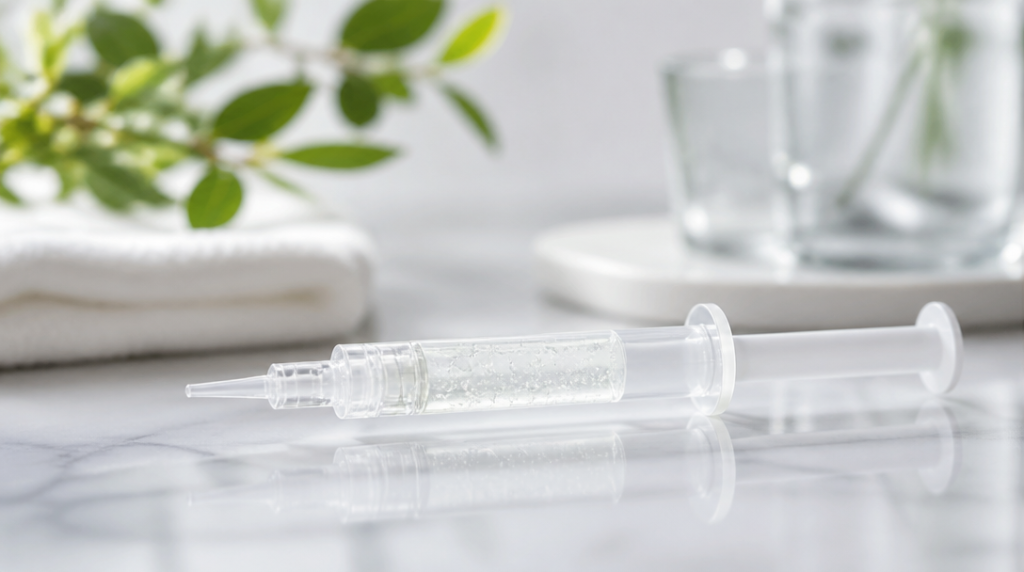
Sourcing consideration: ACP stability in acidic peroxide gels can be problematic. Some formulations separate ACP into a dual-barrel syringe or secondary treatment step. Ask suppliers whether the ACP is pre-mixed or activated at application — stability affects shelf life and claimed efficacy.
Nano-Hydroxyapatite (nHA): The Biomimetic Alternative
nHA is chemically similar to natural enamel mineral, reduced to nanoscale for deeper tubule penetration. Industry analysis identifies nHA as a key ingredient in peroxide-free formulations aimed at reducing dentin hypersensitivity while maintaining acceptable results. The appeal is dual: structural integration with tooth mineral and strong marketing resonance with “biomimetic” and “enamel-safe” positioning.
The catch is that particle size distribution varies enormously between suppliers. nHA at 20nm behaves differently than 200nm aggregates. Request particle characterization data — mean size, polydispersity index, crystallinity. Poorly characterized nHA may clog rather than penetrate tubules, or fail to disperse uniformly in gel matrices. Price points also scatter widely; the cheapest nHA sources sometimes supply standard-grade hydroxyapatite with inadequate particle size reduction.
Potassium Oxalate: The Barrier Former
Potassium oxalate creates precipitates that physically block dentinal tubules. A 2022 randomized, placebo-controlled clinical trial published in PLOS ONE found that 1.5% potassium oxalate prevented whitening-related sensitivity without reducing whitening effectiveness and improved patient satisfaction. This is significant — it demonstrates that desensitization need not trade away shade results, addressing the core buyer concern.
Oxalate’s mechanism differs from nitrate’s neural approach. It forms calcium oxalate crystals on exposed dentin, creating mechanical occlusion. The effect bridges the post-whitening sensitivity window of the first several days. For clinic buyers, this means fewer emergency calls on days one through three post-treatment — the period when sensitivity complaints typically concentrate.

Photo by Elen Sher on Unsplash
How to Read a Whitening Gel Spec Sheet for Sensitivity Protection
Spec sheets hide as much as they reveal. Here is what to actually verify.
Desensitizer concentration, not just presence. “Contains potassium nitrate” means nothing without a number. Is it 0.5% or 5%? Clinical trials demonstrating sensitivity reduction have used specific concentrations — typically 1.5% or higher alongside peroxide actives. Demand quantitative disclosure from every supplier.
Peroxide type and concentration. Hydrogen peroxide diffuses faster through enamel and tends to provoke more acute sensitivity than equivalent carbamide peroxide concentrations. Carbamide peroxide decomposes into hydrogen peroxide plus urea; the urea component raises pH slightly, which may moderate enamel effects. A systematic review of hydrogen peroxide-free color correctors found whitening above perceptibility thresholds while preserving enamel and causing sensitivity in fewer than 3% of subjects. The tradeoff is speed and magnitude of shade change.
pH specification. Acidic gels with pH below 5.5 accelerate enamel demineralization and amplify sensitivity risk. Neutral or slightly alkaline formulations reduce this. Many spec sheets omit pH entirely — request it.
Viscosity and delivery system. Thicker gels with good tissue adhesion reduce gingival contact and subsequent soft-tissue irritation. Tray-based systems allow better isolation than brush-on or strip formats. For spa operators without dental isolation equipment, this matters enormously.
Water content and humectants. Dehydration causes immediate post-treatment sensitivity that resolves with rehydration — patients report discomfort regardless of the mechanism. Glycerin-heavy formulas draw moisture from enamel during wear; post-treatment rehydration protocols help, but water-based or balanced-humectant formulations reduce the phenomenon at the source.
One more thing. “Sensitivity-free” on a product label is marketing language, not a regulated claim category. The EU Cosmetics Regulation (EC No 1223/2009) requires that claims be truthful and substantiated, but enforcement varies across member states. Suppliers making bold sensitivity claims without clinical data are often betting you will not ask for the proof. Ask anyway.
Peroxide-Plus-Desensitizer vs PAP-Only: Callback and Reorder Data Buyers Should Track
This is where purchasing becomes performance management. You need internal metrics, because published studies do not map cleanly to your patient population or service model.
The clinical evidence shows a consistent pattern. Conventional peroxide with desensitizers maintains whitening efficacy while reducing — not eliminating — sensitivity. PAP (phthalimidoperoxycaproic acid) and other peroxide-free systems reduce sensitivity reports but produce more limited color change in head-to-head trials. One peroxide-free strip trial showed the test regimen was well tolerated but demonstrated limited shade improvement versus the peroxide control.
What does this mean operationally? Track these four data points by SKU:
- Callback rate within 72 hours. Phone calls, messages, or unscheduled returns mentioning sensitivity. Target under 5% for professional treatments.
- Completion rate for multi-session protocols. Patients who abandon mid-course because of discomfort represent lost revenue and lost future bookings.
- Shade satisfaction score at two weeks. Not immediate post-treatment — the dehydration rebound confuses early assessment and inflates initial results.
- 90-day reorder rate for maintenance products. Sensitivity during initial treatment suppresses ongoing product attachment and lifetime client value.
Many buyers stock both categories without tracking which patients receive which formula. That is inventory theater. Segment your data. If your clinic serves predominantly younger patients with intact enamel, peroxide-plus-desensitizer likely optimizes shade results with manageable sensitivity. If your spa attracts middle-aged clients with recession and exposed dentin, PAP-only or nHA-enhanced formulas may protect your reputation despite slower visible results.
Sensitivity-free whitening formulas are not one product category. They represent a portfolio strategy. Industry sources confirm that demand for less-sensitizing formulations is pushing peroxide-free gels and LED-activated systems into mainstream distribution. The same sources note refillable applicators gaining traction — suggesting the market is fragmenting into precision-delivery systems, not just ingredient swaps.
Stocking Strategy: Matching Sensitivity-Free SKUs to Clinic, Spa, and Retail Channels
Channel determines everything about formula selection. Not just regulatory status — though that varies significantly — but patient expectation, supervision level, and complaint handling capacity.
Dental clinics: You have isolation capability, professional trays, and the clinical expertise to manage pre-existing sensitivity before treatment. Stock peroxide-plus-desensitizer as your workhorse — 10–20% carbamide with potassium nitrate or potassium oxalate. Reserve PAP-only for the sensitivity-prone subset identified during screening. Consider a two-step system: peroxide gel plus separate desensitizing gel for immediate post-treatment application. The 2022 potassium oxalate trial supports this approach — sensitivity prevention without efficacy loss.
Medical spas and non-dental whitening lounges: Lower clinical supervision, higher liability perception. PAP, nHA, or enzyme-based systems dominate here. The regulatory advantage matters too — in many jurisdictions, non-dental operators face stricter peroxide concentration limits or outright prohibitions. Under EU cosmetic regulations, hydrogen peroxide is capped at 0.1% for products available directly to consumers; the “professional” designation may not apply if no dentist is present or supervising.
Industry data points to at-home LED kits and peroxide-free formulations extending adoption among sensitivity-prone users. For spa retail shelves, these are attachment products — the client who experienced comfortable in-spa whitening buys the maintenance kit. Match the maintenance formula to the treatment formula; mismatched chemistry confuses the client and undermines protocol compliance.
Retail and e-commerce: Strip formats dominate for convenience, but gel syringes with custom trays offer better desensitizer contact and soft-tissue isolation. Clinical trials on strip formats show that strips with integrated desensitizers work, but gel systems allow higher active loading and longer controlled contact. For retail buyers, the trend toward refillable applicators suggests that sustainability positioning can differentiate sensitivity-free whitening formulas in crowded marketplaces.
Distributors: Your challenge is portfolio breadth without inventory bloat. Three tiers work well: premium peroxide-plus-desensitizer for dental professionals, mid-market PAP/nHA for spas and salons, and accessible strip formats for retail. Within each tier, offer two strength variants — standard and intensive — rather than duplicating across desensitizer types.
Supplier Questions That Separate Real Sensitivity Claims From Label Dressing
Most suppliers will answer direct questions; few buyers ask them. Here is the vetting sequence that separates genuine formulation control from marketing.
Question 1: “What concentration of desensitizer is present, and what is the test method for verification?” Vague answers — “proprietary blend,” “clinically tested level” — signal label dressing. Quantitative disclosure with HPLC or similar analytical method indicates genuine formulation control and batch consistency.
Question 2: “Show me the stability data for the desensitizer in your peroxide matrix at 25°C and 40°C.” Potassium nitrate is generally stable; ACP and nHA may degrade or aggregate over time. Accelerated stability testing is standard for pharmaceutical-grade manufacturing; cosmetic-grade suppliers often skip it. If they cannot produce this data, the desensitizer concentration on day one of shelf life may not match the concentration when the product reaches your client.
Question 3: “Do you have clinical trial data — not bench testing — showing sensitivity reduction in human subjects?” Bench studies on extracted teeth demonstrate mechanism. Clinical trials demonstrate real-world performance. The distinction matters because patient variability in enamel thickness, saliva flow, and dentin exposure means bench results routinely overpredict comfort outcomes.
Question 4: “What is the regulatory classification of this product in my target market, and does the sensitivity claim affect that classification?” This is the question that catches suppliers off guard. In the United States, a product marketed as a cosmetic tooth whitener that also claims to treat or prevent sensitivity may cross into drug classification territory. In the EU, cosmetic claims must comply with the Common Criteria for claims under Regulation (EC) No 1223/2009. In Canada, anti-sensitivity claims can trigger Natural Health Product or drug classification. Your supplier should know the answer for your specific jurisdiction — if they do not, the compliance risk falls on you.
Question 5: “Can you provide a certificate of analysis for each batch, including desensitizer assay?” This closes the loop. Certificates of analysis with desensitizer quantification confirm that what the label promises matches what the tube contains. Without batch-level verification, you are relying on the supplier’s formulation intent rather than manufacturing reality.
References
- Evaluating the efficiency of two different over-the-counter tooth whitening systems: a randomised controlled clinical trial. BDJ Open, 2024. Available at: https://pubmed.ncbi.nlm.nih.gov/38821934/
- Effect of 1.5% potassium oxalate on sensitivity control, color change, and quality of life after at-home tooth whitening: A randomized, placebo-controlled clinical trial. PLOS ONE, 2022. Available at: https://pubmed.ncbi.nlm.nih.gov/36395262/
- Amorphous Calcium Magnesium Phosphate Particles for Treatment of Dentin Hypersensitivity: A Mode of Action Study. ACS Biomaterials Science & Engineering. DOI: 10.1021/acsbiomaterials.0c00262
- Regulation (EC) No 1223/2009 of the European Parliament and of the Council on cosmetic products. Available at: https://eur-lex.europa.eu/legal-content/EN/TXT/?uri=CELEX%3A32009R1223
- U.S. Food and Drug Administration — Is It a Cosmetic, a Drug, or Both? Available at: https://www.fda.gov/cosmetics/cosmetics-laws-regulations/it-cosmetic-drug-or-both-or-it-soap
Disclaimer
This article is for informational purposes only. LLRNCARE makes no representations or warranties about the completeness, accuracy, or reliability of the information. Any reliance is at your own risk.
For professional dental advice, consult a qualified dental professional.