
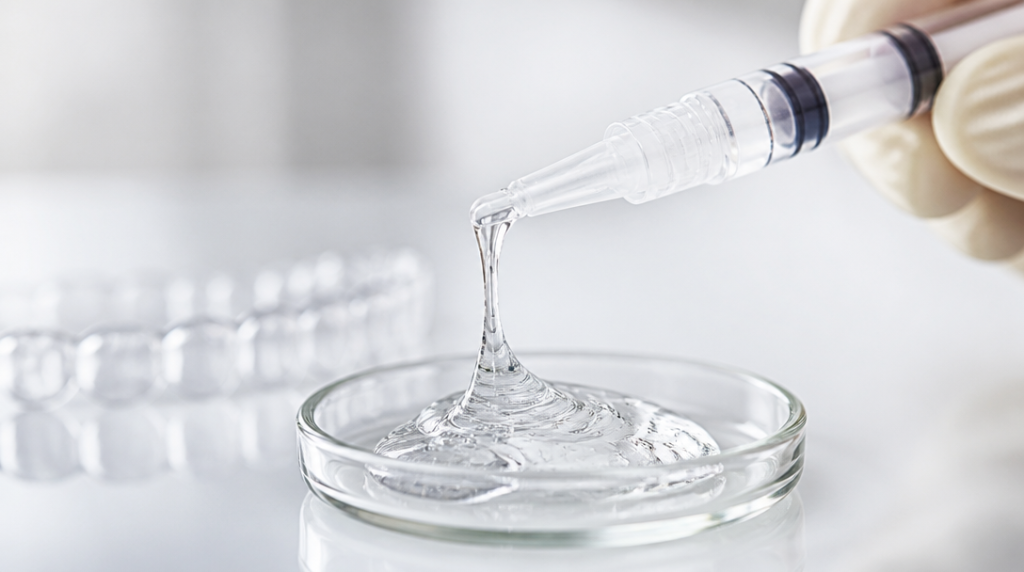
How Professional Whitening Gel Viscosity Affects Treatment Results
Whitening Gel Viscosity: The Performance Factor Most Practitioners Overlook Whitening gel viscosity determines treatment success just as much as peroxide concentration — yet most purchasing decisions still hinge entirely on active ingredient percentage. A 35% hydrogen peroxide gel that flows off tooth surfaces within minutes will consistently underperform a well-formulated 15% gel that maintains full … Read more
Whitening Gel Viscosity: The Performance Factor Most Practitioners Overlook
Whitening gel viscosity determines treatment success just as much as peroxide concentration — yet most purchasing decisions still hinge entirely on active ingredient percentage. A 35% hydrogen peroxide gel that flows off tooth surfaces within minutes will consistently underperform a well-formulated 15% gel that maintains full enamel contact for the entire treatment window.
The reason is straightforward: whitening chemistry requires sustained contact time, not just chemical strength. When a gel loses its position on the tooth surface, the active ingredient disperses into saliva, peroxide concentration at the enamel interface drops, and the treatment window closes before chromophores fully break down. Concentration without retention is concentration wasted.
For professional buyers, dental distributors, and clinic operators evaluating whitening systems, understanding rheological properties is no longer optional — it is a core competency that separates predictable clinical outcomes from inconsistent ones.
The Science Behind Whitening Gel Viscosity and Enamel Penetration
Hydrogen peroxide whitens teeth by diffusing through enamel’s porous microstructure and oxidizing organic chromophore molecules lodged within. Enamel pore diameters range from approximately 4 to 6 micrometers, and effective whitening depends on maintaining an adequate peroxide concentration at that interface long enough for oxidation reactions to complete.
A sticky, viscous whitening gel functions as a controlled-release matrix at the tooth surface. Research published in peer-reviewed dental literature confirms that higher-viscosity formulations improve tooth coverage and retention, keeping active ingredient in contact with enamel rather than allowing it to wash away or migrate toward soft tissues. The clinical science website Clinical Research Dental notes explicitly that sticky, viscous gel helps keep the product on teeth and limits migration — a finding consistent across multiple formulation studies.
Thixotropic behavior is the property that makes professional-grade gels practical to use. A thixotropic gel thins under the shear stress of brush or syringe application, then rapidly recovers its resting viscosity once placed. This means the same gel flows easily during application and resists displacement during treatment — two properties that low-viscosity formulations cannot simultaneously provide.
Carbamide Peroxide vs. Hydrogen Peroxide: A Viscosity-Linked Advantage
Carbamide peroxide systems carry an underappreciated formulation advantage. Because carbamide peroxide breaks down more slowly — releasing hydrogen peroxide gradually over a longer period — these gels tend to maintain consistent active ingredient delivery across extended treatment cycles. Clinical summaries reviewed by Today’s RDH indicate that carbamide peroxide can perform comparably or slightly better in some protocols, likely due to this slower, sustained release mechanism.
Viscosity stability reinforces this advantage. Carbamide peroxide formulations typically demonstrate superior rheological consistency across the intraoral temperature range of 35–37°C, whereas some hydrogen peroxide systems thin more aggressively at body temperature. For extended tray-wear protocols lasting 30–60 minutes, that stability difference meaningfully affects how much active ingredient remains at the enamel surface by the end of the session.
High vs. Low Whitening Gel Viscosity: What the Clinical Data Shows

The performance gap between high and low viscosity formulations is not theoretical. Clinical comparisons tracking whitening outcomes over standardized 14-day protocols consistently show that higher-viscosity gels deliver superior shade improvement — not because the peroxide concentration is higher, but because retention keeps that concentration working longer.
Soft tissue safety follows the same pattern. When gel viscosity is insufficient, formulations migrate toward the gingival margin during normal oral function — speaking, swallowing, minor jaw movement. The result is soft tissue irritation, increased sensitivity reports, and, in worst cases, chemical burns to the gingiva. Gels with appropriate viscosity profiles reduce soft tissue contact by remaining where they were applied rather than flowing into sulcular spaces.
Sensitivity incidence data, summarized by clinical sources tracking whitening outcomes, confirms that sensitivity remains the most common adverse event in professional whitening — and that formulation properties, including viscosity and controlled-release characteristics, are among the modifiable variables practitioners can act on. Choosing a gel that maintains its position and releases peroxide at a controlled rate is a direct intervention against unnecessary pulpal irritation.
The Retention Window: Why the First 20 Minutes Are Critical
Peroxide oxidation of tooth chromophores is most efficient during the initial contact period, when the concentration gradient between gel and enamel is steepest. Gels that retain their active ingredient concentration across this window drive the deepest chromophore breakdown.
Low-viscosity formulations face compounding losses: saliva dilution reduces peroxide concentration, gravitational flow repositions the gel away from target surfaces, and normal oral muscle activity displaces the gel entirely in mobile areas like the cervical third. High-viscosity systems resist all three loss mechanisms simultaneously. For in-office protocols using higher peroxide concentrations — typically 25–35% hydrogen peroxide — this retention difference is especially consequential because the treatment session is brief and reapplication is limited.

Temperature Stability: How Intraoral Conditions Affect Gel Performance
Every whitening gel placed in the mouth immediately encounters a thermal challenge. Intraoral temperature sits between 35–37°C — consistently warmer than the ambient conditions under which gels are stored and tested. Formulations that are not engineered for thermal stability can lose a substantial portion of their initial viscosity within the first few minutes of treatment.
Thermally unstable gels transition from adherent matrices into flowing liquids at body temperature. This viscosity collapse is invisible to the clinician but directly reduces retention, increases soft tissue exposure risk, and produces uneven whitening — particularly in posterior regions where saliva pooling accelerates dilution. Patients experiencing blotchy or patchy results after otherwise standard protocols are frequently experiencing the downstream effects of formulation instability rather than technique errors.
Advanced formulations address this through temperature-compensating thickening agents, including hydroxypropyl methylcellulose (HPMC) and carbomer polymer systems. These agents maintain viscosity stability across the 20–40°C range, ensuring that the gel a clinician applies at room temperature behaves consistently throughout the treatment cycle rather than degrading mid-session.
What Quality Control Should Verify
Responsible manufacturers test viscosity stability at 37°C over 30-minute intervals under conditions that replicate intraoral exposure. Gels demonstrating significant viscosity reduction during this test — beyond acceptable formulation tolerances — will perform poorly in clinical use regardless of how they behave in ambient storage conditions.
Batch-to-batch consistency matters equally. Viscosity variation between production lots creates unpredictable clinical behavior: a product that performed well in initial evaluation may perform differently from the next shipment if the supplier lacks rigorous statistical process control. Professional buyers should request temperature stability data and lot-to-lot viscosity records before committing to a supply relationship.
Matching Whitening Gel Viscosity to Application Method
Not all whitening delivery systems place the same rheological demands on a gel. Understanding how viscosity requirements shift across application methods allows buyers to specify correctly rather than defaulting to a single formulation for every protocol.
Custom Tray Systems
Custom tray applications require gels that remain fully contained within the tray reservoir throughout extended wear. Overflow into soft tissues during tray insertion or wear is a direct function of inadequate viscosity — the gel simply does not hold its position under the compressive force of tray seating. Higher-viscosity carbamide peroxide formulations are the standard of care for overnight or extended-wear tray protocols precisely because they combine chemical stability with rheological stability over long periods.
The gel must still flow sufficiently during tray loading and insertion to distribute evenly across all tooth surfaces. This is where thixotropic tray whitening formulations provide a genuine clinical advantage — they thin under the brief mechanical stress of tray seating and immediately recover viscosity once the tray is in position.
In-Office Power Whitening
In-office protocols using 25–35% hydrogen peroxide operate on compressed time windows, typically 15–20 minutes per application cycle. Gel must adhere firmly to tooth surfaces without gingival barrier failure while still allowing sufficient light penetration in light-activated systems. Formulations that trap air bubbles due to excessive viscosity scatter activation light and reduce system efficiency; conversely, formulations that are too thin migrate under the gingival barrier and increase soft tissue risk.
Light-activated systems have an additional requirement: the gel must not flow when illuminated, as heat from LED or laser sources can temporarily lower surface viscosity. Formulations engineered for in-office use account for this thermal input in their rheological profiles.
Brush Application Systems
Brush-applied professional gels perform best at moderate viscosity ranges that spread easily under brush pressure but resist dripping or running between application and patient closure. Thixotropic behavior is again the key property — the gel thins under brushing shear, covers interproximal spaces and cervical surfaces, then stiffens in place before the patient bites down or closes the tray.
Viscosity Testing Standards Every Professional Buyer Should Require
Purchasing whitening gels without viscosity data is equivalent to purchasing local anesthetic without concentration data. The information exists, credible manufacturers produce it, and absence of documentation is itself a meaningful signal about a supplier’s quality control capabilities.
Standard rheological testing uses a Brookfield viscometer with measurements taken at both 25°C (ambient) and 37°C (intraoral). These dual-temperature measurements reveal thermal behavior that ambient-only testing conceals. Spindle selection and rotational speed should be consistent across comparative evaluations to produce interpretable data.
Thixotropy can be assessed through recovery testing: measure viscosity immediately after shear, then at 30-second intervals during rest. Gels with strong thixotropic recovery return to near-resting viscosity within 60–90 seconds. This recovery speed correlates directly with how effectively the gel holds position after clinical application.
Temperature cycling tests — running gels through multiple heating and cooling cycles between storage temperature and body temperature — reveal formulation stability under real-world conditions. A gel cycled five times between 20°C and 40°C should retain consistent rheological properties; significant degradation during this test predicts poor shelf-life performance and unpredictable clinical behavior after shipping and storage.
For buyers evaluating competing whitening systems, requesting a technical data sheet with viscosity specifications, temperature stability data, and lot-to-lot variation tolerances is a reasonable and professional ask. Suppliers who cannot or will not provide this information present a supply chain risk that extends well beyond viscosity — it reflects on their overall manufacturing rigor.

The Practical Case for Prioritizing Gel Rheology in Purchasing Decisions
Professional whitening is a competitive service category. Patients research outcomes, compare clinics, and make repeat-visit decisions based on results and comfort. Practices that consistently deliver strong shade improvements with low sensitivity incidence build the referral volume and retention rates that drive practice growth.
Gel viscosity is one of the few formulation variables that practitioners can actively specify — and one where the performance differential between well-formulated and poorly formulated products is clinically meaningful. The professional-grade whitening systems that support the best outcomes combine appropriate peroxide concentration with engineered rheological properties: thixotropic behavior for clean application, temperature-stable viscosity for consistent intraoral performance, and sufficient adhesion to maintain tooth contact through the full therapeutic window.
Peroxide percentage still matters. But a gel that stays where it is applied, maintains its active ingredient concentration at the enamel surface, and minimizes soft tissue migration will outperform a higher-concentration gel that does none of those things. Understanding whitening gel viscosity — and demanding documentation of it from suppliers — is how professional buyers move from acceptable results to consistently excellent ones.
References
- Dental Whitening Gels: Strengths and Weaknesses of an Increasingly Used Method. PMC / National Library of Medicine.
- Evaluating the Effectiveness of Two Whitening Formulations and a Barrier Gel Pen: an Ex-vivo Study. Genesis Publishing.
- The Science Behind Teeth Whitening. Clinical Research Dental.
- What the Research Shows Regarding the Efficacy of Dental Whitening Options. Today’s RDH.
- Teeth Whitening: Related Statistics on Effectiveness and Sensitivity Incidence. Loud Family Dentistry.
- U.S. Food and Drug Administration: Dental Bleaching Products / Tooth Whitening Guidance. FDA.gov.
Disclaimer
This article is for informational purposes only. LLRNCARE makes no representations or warranties about the completeness, accuracy, reliability of the information. Any reliance is at your own risk.
For professional dental advice, consult a qualified dental professional. For regulatory compliance, consult legal experts.
—