
Nano-Hydroxyapatite Whitening: What Buyers Should Stock
Nano-Hydroxyapatite Whitening: What Buyers Should Stock in 2026 Nano-hydroxyapatite whitening has crossed from specialty remineralization category into a line item that dental clinic buyers, spa operators, and distributors are actively budgeting for — and the buyers who understand the science and the regulatory landscape will stock ahead of demand rather than scramble to catch it. … Read more
Nano-Hydroxyapatite Whitening: What Buyers Should Stock in 2026
Nano-hydroxyapatite whitening has crossed from specialty remineralization category into a line item that dental clinic buyers, spa operators, and distributors are actively budgeting for — and the buyers who understand the science and the regulatory landscape will stock ahead of demand rather than scramble to catch it. This article covers the mechanism, the evidence limits, the specification checkpoints, and the commercial logic you need to make confident purchase decisions.
Why Practitioners Are Adding Nano-Hydroxyapatite Whitening to Their Menus
The core driver is a documented shift in what sensitivity-prone patients and retail consumers request: brightness without discomfort. For dental clinics and spa operators, n-HA gives you a product positioned as a gentle, enamel-supporting whitening pathway that sits alongside, not against, your existing peroxide protocols.
The commercial logic is direct. A clinic that offers a low-sensitivity maintenance product for patients who have completed peroxide bleaching improves retention and raises take-home basket value. Distributors consistently report that assortments carrying a remineralizing whitening SKU convert better with practitioners serving sensitivity-prone demographics.
There is also a category tailwind. The global hydroxyapatite market is on a growth trajectory driven by dental and cosmetic demand — a signal that private-label opportunities and supplier relationships secured now will carry stronger value across the coming buying cycles. That trend context is what you use internally when justifying shelf space to a category manager.
One discipline before you commit purchase orders: the evidence base, while promising, is described in peer-reviewed systematic reviews as preliminary, with explicit calls for more and better-controlled clinical trials. That does not mean you avoid the category — it means you calibrate claims carefully, which is precisely what the rest of this article addresses.
Two Separate Claims: How Nano-Hydroxyapatite Whitening Works vs. How It Repairs

Buyers routinely conflate two distinct mechanisms, and that confusion becomes a compliance liability the moment it reaches a product label. Keep them separate from the first supplier conversation.
The whitening mechanism is primarily surface and optical. Fine n-HA particles deposit onto and integrate with the enamel surface, filling micro-defects and creating a smoother, more light-reflective surface that reads as brighter. This is not chemical bleaching — n-HA does not oxidize chromophores the way hydrogen or carbamide peroxide does. A systematic review of hydroxyapatite-containing oral care products concluded that regular use effectively whitens teeth across available in vitro and in vivo studies, while noting that more clinical trial data are needed.
The repair claim is a different mechanism entirely. Published reviews describe n-HA dentifrices as effective at remineralizing the enamel surface and reducing white spot lesions, with one review framing n-HA explicitly as a healthier whitening option precisely because of that remineralization pathway. However, a separate systematic review and meta-analysis focused specifically on white spot lesions found promising remineralization effects but no clear color improvement in those lesions, with evidence quality limited by bias and short follow-up periods.
The practical consequence for buyers: “it remineralizes white spots” and “it whitens the whole tooth” are supported by different bodies of evidence and must not be collapsed into a single marketing sentence. When you brief your copy team or vet a supplier’s claims deck, insist that whitening and remineralization assertions are each tied to the correct mechanism — and flag any copy that blends them.
Particle Size and Concentration Specs That Matter on a Spec Sheet
The spec sheet is where you catch weak formulations before they reach your customers. Two variables dominate the evaluation.
Concentration
An experimental toothpaste study found the whitening effect to be concentration-dependent, with the authors noting that levels up to around 10% may be visually perceptible while remaining biologically safe within the parameters of their study. Use that finding as a practical benchmark — a product claiming visible whitening at a trace concentration deserves rigorous scrutiny before you place a volume order.
Require suppliers to state n-HA concentration explicitly as a weight percentage, not a vague “contains nano-hydroxyapatite.” A named percentage lets you compare SKUs objectively and gives your customers a meaningful data point for what they are paying a premium to receive. A supplier that refuses to disclose concentration is telling you something about the formulation.
Particle Size
The “nano” designation is not cosmetic labeling — it describes a functional difference. Sub-micron particles behave differently on enamel than larger particulate hydroxyapatite; it is the fine particle size that enables surface integration and the light-reflective smoothing effect associated with whitening. Request the particle size range on the certificate of analysis and confirm it aligns with the nano claim rather than being micro-scale hydroxyapatite relabeled for marketing purposes.
Third, evaluate delivery format and the broader formulation context. Nano-hydroxyapatite whitening in a toothpaste behaves differently from n-HA in a leave-on serum or an adhesive strip, and abrasivity — measured as RDA in dentifrices — interacts with both your whitening performance claims and your safety positioning. On any significant volume order, require the RDA value, the n-HA weight percentage, and the particle size specification in writing before signing, and hold incoming batches against the COA on delivery.

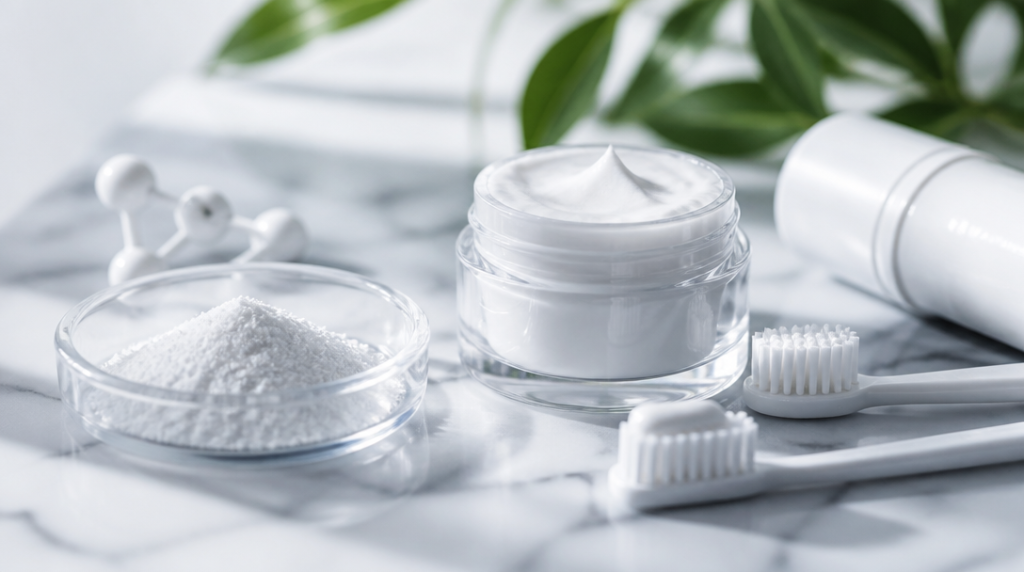
Photo by www.kaboompics.com on Pexels
Reading Nano-Hydroxyapatite Whitening Claims Against Labeling Rules
Regulatory classification is where n-HA products create the most risk for unprepared buyers, because the same formulation can carry different compliance obligations depending on the claims made and the destination market.
North America
The FDA maintains an established OTC toothpaste monograph framework covering anticaries and cosmetic oral-care products. Critically, nano-hydroxyapatite is not established as a recognized active ingredient within the current cited regulatory sources — meaning you must determine whether each product is marketed as a cosmetic or as a drug and whether it complies with the applicable pathway. A product making a therapeutic anticaries or remineralization “treatment” claim can be pushed toward drug classification, carrying a substantially heavier compliance burden than a straightforward cosmetic whitening or appearance claim. Ask your supplier which classification they market under in each destination country and get it in the product documentation before you commit shelf space.
EU and UK
In the EU and UK, the “nano” prefix carries specific labeling obligations. Nanomaterials present in cosmetic formulations must typically be identified with (nano) in the INCI ingredient list. A non-compliant label can hold an import shipment at customs, turning a fast-moving SKU into tied-up working capital. Confirm your supplier’s INCI declaration handles nano notation correctly for each target market, and request a copy of the finished-product regulatory dossier — the classification, INCI declaration, and any claim substantiation the supplier holds — before you commit to a container.
Distributors who skip this step frequently find themselves holding stock they cannot legally sell across part of their footprint. Build the regulatory document request into your standard purchase-order checklist and apply it without exception.
Where n-HA Fits Alongside PAP and Peroxide in a Product Range
Nano-hydroxyapatite whitening should not replace your peroxide line — it should complete it. A published review positions synthetic n-HA as an alternative whitening option with effects demonstrated across in vitro and in vivo studies, while being explicit that it is generally less powerful than peroxide bleaches. That single sentence should govern how you merchandise the three available whitening chemistries.
Think in tiers:
- Peroxide (hydrogen or carbamide): Your intensive shade-change engine — the professional in-chair and prescription take-home tier where dramatic results justify premium pricing and sensitivity management is built into the protocol.
- PAP (phthalimidoperoxycaproic acid): A peroxide-free oxidizing option for buyers serving markets where peroxide labeling constraints apply or where patients specifically request a peroxide-free formula.
- Nano-hydroxyapatite whitening: The low-sensitivity, enamel-supporting tier — your maintenance and gentle-whitening product, ideal for post-treatment care and for the sensitivity-prone patient who abandons peroxide protocols before completing a course.
Rather than competing, these three chemistries cross-sell. A clinic that completes a peroxide course can hand the patient an n-HA maintenance paste at dispensary. A retailer can position n-HA beside peroxide strips as the everyday option for patients in between professional treatments. The cross-sell story is what you bring to a clinic buyer who already carries your peroxide SKU.
For assortment planning, prioritize at least one SKU per chemistry rather than three overlapping peroxide products at different price points. When a clinic can source peroxide intensive and n-HA maintenance from the same distributor, their procurement simplifies and your account is harder to displace. Frame the n-HA line to your buyers as basket expansion, not category cannibalization.
Supplier Due Diligence: Synthetic vs. Bio-Derived and COA Discipline
Once you have decided to stock the category, supplier vetting separates a reliable margin from a recall risk. Start with the raw material origin. The peer-reviewed literature evaluating whitening effects specifically describes synthetic nano-hydroxyapatite, which offers batch-to-batch consistency in particle size and purity that bio-derived material may vary on. Neither source is inherently disqualified, but you need to know which you are buying and hold the supplier to documented consistency standards.
If a supplier offers bio-derived n-HA, ask what controls exist for heavy metals and biological contaminants. That answer shapes both your safety documentation and the marketing story you can credibly tell downstream buyers.
Build a standing supplier documentation checklist and apply it before any purchase order is signed:
- COA per batch: n-HA identity, weight concentration, particle size range, purity, and heavy-metal limits
- Regulatory classification: cosmetic or drug designation per target market
- INCI declaration: correct nano labeling notation confirmed for EU/UK shipments
- Claim substantiation: documentation the supplier actually holds, not a general reference to published studies
- Stability data: supporting the stated shelf life under expected storage conditions
A supplier that produces these documents promptly has operated at scale and built a quality system around them. One that stalls or provides incomplete documentation is flagging a systemic gap — and that gap becomes your liability once the product is on your shelves.
On claim substantiation specifically: the systematic reviews in the literature are candid that evidence quality is limited and that more rigorous clinical trials are needed. A serious supplier keeps its on-label claims within what its own substantiation file actually supports, rather than importing broad statements from general research. Require the same discipline from any supplier you consider a long-term partner.
Margin, Positioning, and Which Buyer Segments Move Nano-Hydroxyapatite Whitening Stock Fastest
Because n-HA carries a “healthier whitening” narrative — supported in the literature by its remineralization mechanism and its sensitivity profile relative to peroxide — it supports premium positioning over commodity whitening pastes without requiring aggressive discounting to generate trial. The claim is substantiated; the price premium follows from the substance.
The buyer segments that move n-HA stock fastest share one characteristic: they serve patients or retail customers who have experienced sensitivity with peroxide and need a credible, professionally endorsed alternative. Dental clinics with active post-whitening protocols, holistic and biological dental practices, and spas offering wellness-oriented facial and oral-care menus are your fastest-turning accounts. Retailers positioned in the premium natural or health-focused tier convert n-HA at higher average transaction values than mass-market channels.
Distributors building assortments for these segments should lead with the dual-benefit positioning — whitening and enamel support — and equip account managers with a one-page evidence summary drawn from published systematic reviews. Practitioners respond to sourced claims; unsupported superlatives generate skepticism in a clinical buying environment.
Finally, train your sales team on what nano-hydroxyapatite whitening does not do as clearly as what it does. It is not a replacement for a professional peroxide treatment when significant shade change is the objective. Positioning it accurately — and within the evidence — builds the practitioner trust that turns a trial order into a standing replenishment account.

Photo by Peter Döpper on Pexels
References
- The effect of nano-hydroxyapatite on white spot lesions: A systematic review and meta-analysis. PubMed, NCBI.
- Tooth Whitening with Hydroxyapatite: A Systematic Review. PMC, National Library of Medicine.
- Tooth whitening with an experimental toothpaste containing nano-hydroxyapatite. PMC, National Library of Medicine.
- Hydroxyapatite in Oral Care Products — A Review. PMC, National Library of Medicine.
- Nano-Hydroxyapatite (nHAp) in the Remineralization of Early Caries Lesions. PMC, National Library of Medicine.
- Toothpaste — Regulatory Framework for OTC Oral Care Products. U.S. Food and Drug Administration.
Disclaimer
This article is for informational purposes only. LLRNCARE makes no representations or warranties about the completeness, accuracy, reliability of the information. Any reliance is at your own risk.
For professional dental advice, consult a qualified dental professional. For regulatory compliance, consult legal experts.