
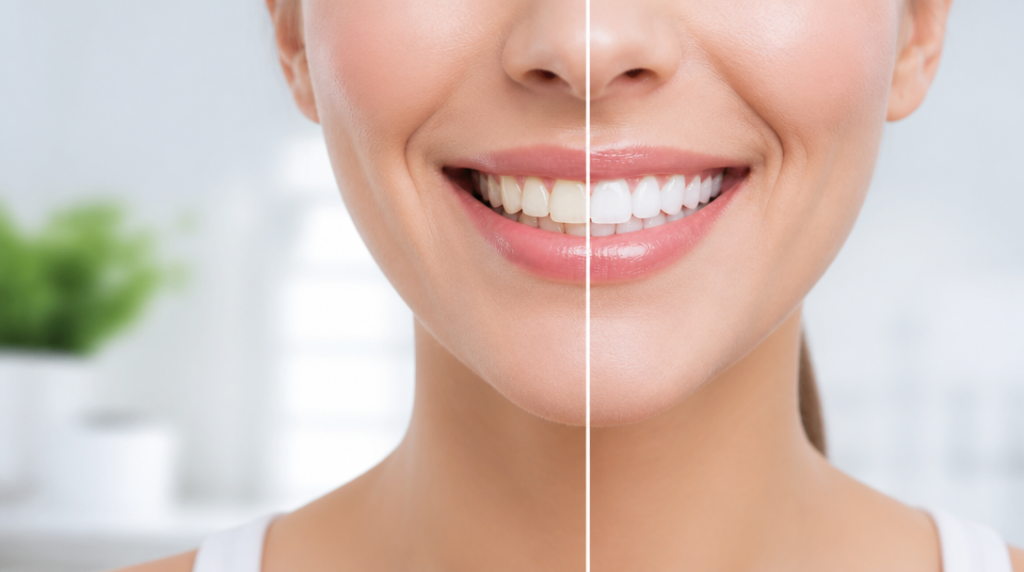
Teeth Whitening Myths Your Dentist Wishes You’d Stop Believing
Here is the thing about teeth whitening myths: they sound right. A friend swears by charcoal. An influencer mixes lemon juice and baking soda on camera. Packaging screams “enamel-safe” in green lettering. Your brain wants to believe because white teeth feel like the easiest win in self-care. The problem? Believable misinformation costs you money, time, … Read more
Here is the thing about teeth whitening myths: they sound right. A friend swears by charcoal. An influencer mixes lemon juice and baking soda on camera. Packaging screams “enamel-safe” in green lettering. Your brain wants to believe because white teeth feel like the easiest win in self-care.
The problem? Believable misinformation costs you money, time, and sometimes irreplaceable tooth structure. This article pairs each persistent myth with the clinical mechanism that disproves it. Once you understand how whitening actually works at the molecular and structural level, you will spot nonsense before you reach for your wallet.
Why Whitening Myths Spread Faster Than Facts
Social media rewards visual transformation. A 30-second reel of someone brushing with black paste and revealing gleaming teeth gets shared because the contrast is satisfying. No one films the six-month follow-up showing thinned enamel or the sensitivity that wakes them at 2 AM.
Packaging claims exploit gray areas in regulation. In the United States, many tooth-whitening products marketed solely to improve appearance are regulated by the FDA as cosmetics and generally do not require premarket approval, although companies must still ensure safety, proper labeling, and claim substantiation. Products making therapeutic claims—such as treating disease—may be regulated as drugs or devices under different requirements. Terms like “natural,” “gentle,” or “enamel-safe” lack specific FDA cosmetic definitions, though the FTC can take action against advertising claims that are false, misleading, or unsubstantiated. Companies design labels to trigger associations with health and science—mint green accents, molecular-looking graphics, percentages that sound precise—knowing many consumers will not investigate further.
We trust anecdote over data because stories feel concrete. “My cousin used turmeric and her teeth look amazing” beats “clinical trials show inconsistent results with high variability” every time. The myth becomes folk wisdom; the mechanism gets lost.
Dentists see the damage. Not immediately—sometimes years later, when the cumulative effects of acidic DIY pastes or abrasive powders finally manifest as notched incisors, translucent edges, or chronic sensitivity that no desensitizing toothpaste touches. By then, the original “hack” poster has moved on to selling something else.

Myth: Whitening Destroys Your Enamel
This one persists because it feels intuitively correct. You’re applying chemicals to teeth. Chemicals dissolve things. Therefore, whitening dissolves enamel. Simple—but wrong.
Enamel isn’t a passive surface waiting to be eaten away. It is roughly 96 percent mineral by weight, mostly hydroxyapatite crystals arranged in a dense, ordered structure. For peroxide to “destroy” it, you would need either extreme acidity that demineralizes the crystal lattice or physical abrasion that fractures the rods. Standard whitening peroxides do neither.
Here is what happens instead. Carbamide peroxide or hydrogen peroxide penetrates enamel through microscopic pores and channels between the rods. Once in the underlying dentin, the peroxide breaks down into reactive oxygen species—unstable molecules that attack the long-chain organic pigments trapped in the tooth structure. These pigments fragment into smaller, colorless molecules. The enamel itself remains largely untouched. Published research, including scanning electron microscopy studies, indicates that properly formulated peroxide gels at standard concentrations cause no significant structural change to enamel when used as directed. SEM images show the characteristic rod-and-interrod pattern intact after controlled peroxide exposure—no etching, no crater formation, no measurable loss of surface integrity.
Where this myth gets dangerous is when people avoid legitimate whitening products and turn to acidic DIY alternatives—lemon juice, strawberry paste, apple cider vinegar—that actually do demineralize enamel. Fear of safe peroxide drives people to methods that cause the very damage they wanted to avoid.
Overuse still matters. Concentrated peroxide left on teeth for hours beyond recommended contact times can dehydrate enamel temporarily, creating a chalky appearance that resolves with saliva exposure. Professional supervision exists for a reason: to match concentration and contact time to your specific enamel thickness and existing sensitivity. If you are considering a professional approach, understanding how dental care professionals evaluate your teeth beforehand can help set realistic expectations.
Myth: Baking Soda and Lemon Juice Work Just as Well as Store-Bought Products
The appeal is obvious. Cheap ingredients from your kitchen. No “chemicals” (everything is a chemical, but that is another conversation). Natural, which somehow equals safe in the collective imagination.
Start with pH. Enamel begins demineralizing at approximately pH 5.5—a threshold consistently referenced in dental literature. Lemon juice sits around pH 2 to 2.4. At that level, hydrogen ions pull phosphate and calcium ions out of hydroxyapatite crystals and into solution. Your saliva can remineralize minor damage, but repeated daily assaults overwhelm this repair capacity. The result is permanent enamel loss, not whitening.
Baking soda (sodium bicarbonate, pH around 8.3) seems like it would neutralize the lemon. It doesn’t fully. Mixing the two creates a brief fizzing reaction that produces carbon dioxide, water, and sodium citrate. The resulting solution remains acidic if you started with enough lemon juice. You are also applying an abrasive paste with unpredictable pH to your teeth. The scrubbing action removes surface stains mechanically—yes, your teeth look slightly brighter afterward—but it also wears enamel with every use.
Compare this to how legitimate whitening works. Peroxide oxidizes internal pigments without mechanical removal of tooth structure. The color change comes from chemical alteration of stain molecules, not from stripping away layers. Kitchen chemistry cannot replicate this because neither baking soda nor lemon juice produces reactive oxygen species in the dentin. They work on the surface, destructively, while peroxide-based whitening works throughout the tooth structure, chemically.
The pH damage threshold is not negotiable. Once enamel crystals dissolve, they do not regrow in their original organized form. Saliva deposits mineral, but it is amorphous and less acid-resistant than the original structure. Each lemon juice session makes the next one more damaging.
Store-bought products are not perfect. Some whitening toothpastes are overly abrasive. Some strips cause sensitivity. But they are formulated with pH buffers, controlled peroxide release, and abrasivity indices tested against enamel wear. Your kitchen lacks quality control. For a broader look at oral health fundamentals, starting with evidence-based basics beats improvising with pantry ingredients.
Myth: Whiter Teeth Are Always Healthier Teeth
This requires understanding dentin—the layer beneath enamel. Yellowish, softer, and full of microscopic tubules running from pulp to enamel junction, dentin determines most of your tooth color. Enamel is translucent. It does not hide dentin; it modulates how dentin color reaches your eye. Thin enamel allows more dentin to show through, yielding yellower teeth. Thick, opaque enamel creates a whiter appearance. Both scenarios can represent perfectly healthy tooth structure.
Age plays a predictable role. Young enamel has a bluish-white opalescence at the incisal edges where light passes through. With age, enamel thins and dentin thickens. Teeth naturally shift toward amber and gray. This is structural maturation, not disease.
What does shade actually indicate? Mostly genetics and age. Some people naturally have thicker, more opaque enamel. Others have denser, more deeply colored dentin. Neither is inferior. The ultra-white standard seen in entertainment and advertising is largely a product of digital editing, professional lighting, and porcelain veneers—not biology.
This myth causes real harm in both directions. People with naturally yellow-tinged but structurally sound teeth pursue aggressive whitening, sometimes to the point of chemical burns or obsessive retreatment. Others ignore actual problems—decay, infection, enamel hypoplasia—because their teeth appear “white enough.” Color correlates poorly with structural integrity. A nonvital tooth can be brilliantly white externally while necrotic internally. A tooth with excellent periodontal support and zero decay might register as a warm A3 on the shade guide rather than the bright B1 patients request.
Dentists evaluate health through radiographs, probing depths, vitality testing, and structural examination. Shade is cosmetic information, not diagnostic data. The best-looking tooth in the mouth can be the most compromised. The slightly yellow incisor with intact enamel and healthy pulp? That is the keeper.
If you are whitening, do it because you want to, not because you have confused aesthetics with health. A dentist can tell you whether your desired shade is achievable given your enamel thickness and dentin color, or whether pursuing it would require veneers that remove healthy structure. Sometimes the healthy choice is accepting your natural color.
Myth: Charcoal and Turmeric Whiten Teeth Safely
Charcoal is abrasive. Turmeric is a pigment. These are material properties that make the “whitening” claim mechanically questionable. Both dominate social media because the before-and-after photography is compelling and the ingredients feel ancient and authentic.
The distinction between oxidation and abrasion matters here. Legitimate whitening uses oxidation: peroxide-derived reactive oxygen species break carbon-double-bond chromophores in dentin pigments into smaller, less light-absorbing molecules. The tooth structure remains. The color changes chemically.
Abrasion removes material. Charcoal powders and pastes function as fine abrasives. They physically scour away surface stains—coffee, wine, plaque—along with a thin layer of enamel. Teeth look brighter temporarily because the stained outer layer is gone. But enamel does not regenerate. Each brushing thins it, gradually exposing the yellower dentin beneath and making teeth more discolored over time.
The relative dentin abrasion (RDA) scale quantifies this risk. Many dental organizations recommend toothpastes below RDA 250. Some charcoal products tested in published studies have exceeded this threshold, while others do not publish RDA values at all. Without standardized testing on the label, consumers cannot compare. The word “activated” in activated charcoal refers to increased surface area for adsorption, not safety for oral tissues. The mechanical scrubbing action still dominates—and damages.
Turmeric is stranger still. It is literally orange-yellow. The whitening claim relies on supposed anti-inflammatory properties or the abrasive quality of the powder mixed into paste. But turmeric contains curcumin, a potent pigment that binds to enamel and stains it. Dentists regularly remove turmeric staining during professional cleanings. The temporary brightening some people report? Likely from the abrasive base—often baking soda or salt in DIY recipes—stripping surface enamel, with turmeric staining masked by dehydration or lighting adjustments in photos.
Long-term tooth structure depends on preserving enamel thickness and surface integrity. Abrasion compromises both. Oxidation preserves both. The distinction is the difference between maintenance and destruction. When you choose charcoal or turmeric, you are not choosing a “natural alternative” to peroxide. You are choosing a fundamentally different and damaging mechanism because the actual whitening mechanism cannot be replicated with kitchen ingredients.
Dental professionals frequently see patients who used charcoal for months, proud of their initial results, now alarmed by increasing yellowing and temperature sensitivity. The enamel they stripped away took years to form. It does not come back.
Myth: Sensitivity Means the Product Is Working
This myth serves manufacturers too well. Discomfort reframed as proof of efficacy is clever marketing but terrible physiology.
Understanding why requires meeting the dentinal tubule. These microscopic channels—roughly 1 to 2 micrometers in diameter, numbering in the millions per tooth—run from the pulp chamber, where nerves reside, through the dentin toward the enamel. In healthy teeth, they are partially occluded with mineral deposits or covered by intact enamel and gum tissue. When exposed or unblocked, they become pathways for pain signals.
The hydrodynamic theory explains the mechanism. Fluid inside these tubules moves in response to temperature changes, osmotic gradients, or physical pressure. Outward flow triggers mechanoreceptors connected to A-delta nerve fibers—producing sharp, sudden pain. Your brain registers this as tooth sensitivity, sometimes intensely.
Whitening peroxide can increase tubule fluid movement in several ways. Dehydration from the gel base changes osmotic pressure across the tubule. Peroxide itself may temporarily alter smear layer proteins that partially block tubule openings. Some formulations run acidic enough to demineralize the minerals occluding those openings. The result: fluid shifts, nerve stimulation, and pain.
None of this is “working.” It is a side effect. The whitening itself—oxidation of pigment molecules—occurs independently of tubule fluid movement. Effective whitening with zero sensitivity is achievable through well-formulated products containing desensitizing additives like potassium nitrate or hydroxyapatite. Conversely, severe sensitivity can accompany minimal color change when gels are overly acidic, used beyond recommended duration, or applied over pre-existing gum recession.
When should sensitivity prompt concern? Prolonged pain persisting hours after gel removal, spontaneous aching without a thermal trigger, or pain localized to specific teeth that worsens over subsequent sessions. These patterns may suggest pulpal inflammation, crack propagation, or chemical irritation that requires professional evaluation. “Powering through” can lead to irreversible pulpitis—inflammation of the nerve tissue—and potential root canal therapy.
Legitimate whitening products now incorporate tubule-occluding agents and desensitizers designed to reduce fluid movement during treatment. Published clinical trials have evaluated protocols combining potassium nitrate or calcium phosphate with bleaching gels and found meaningful reductions in sensitivity without compromising whitening outcomes. If a product causes significant pain, the correct response is to stop and consult a dentist—not to interpret suffering as progress. For more on recognizing when symptoms signal something worth investigating, context matters more than endurance.
What Actually Works—And What to Ask Your Dentist
If this article has done its job, you now understand that whitening is a chemical process—oxidation of organic pigments by peroxide-derived reactive oxygen species—and that anything claiming whitening results through abrasion, acidity, or unspecified “natural” action deserves skepticism.
Effective, evidence-supported whitening falls into a few categories:
- In-office professional whitening: Higher-concentration hydrogen peroxide applied under professional supervision, with soft tissue isolation and controlled contact time. Produces the fastest visible results with the lowest risk of misuse.
- Custom-tray home whitening: Dentist-fabricated trays with prescribed carbamide peroxide concentrations, typically 10 to 22 percent. Allows gradual whitening over days to weeks with consistent gel contact and minimal waste.
- Over-the-counter strips and gels: Lower-concentration hydrogen peroxide products available without prescription. Effective for mild to moderate staining when used according to package instructions. Less predictable than professional options due to one-size-fits-all tray fit.
Before starting any whitening regimen, ask your dentist these questions:
- Is my enamel thick enough to tolerate the concentration and duration of treatment I am considering?
- Do I have existing restorations—crowns, veneers, or bonding—that will not respond to peroxide and may create mismatched shading?
- What is the cause of my discoloration? Extrinsic staining from coffee and wine responds differently than intrinsic staining from tetracycline exposure or fluorosis.
- Do I have active decay, gum recession, or cracked teeth that need treatment before whitening is safe?
Not every tooth needs to be whiter. Not every shade goal is achievable without structural compromise. The best whitening decision is an informed one—made with a clinician who has examined your teeth, not an algorithm that has examined your browsing history.
References
- Joiner, A. (2006). The bleaching of teeth: A review of the literature. Journal of Dentistry, 34(7), 412–419. https://doi.org/10.1016/j.jdent.2006.02.002
- Dahl, J. E., & Pallesen, U. (2003). Tooth bleaching—a critical review of the biological aspects. Critical Reviews in Oral Biology & Medicine, 14(4), 292–304. https://doi.org/10.1177/154411130301400406
- Featherstone, J. D. B. (2008). Dental caries: A dynamic disease process. Australian Dental Journal, 53(3), 286–291. https://doi.org/10.1111/j.1834-7819.2008.00064.x
- Brooks, J. K., Bashirelahi, N., & Reynolds, M. A. (2017). Charcoal and charcoal-based dentifrices: A literature review. Journal of the American Dental Association, 148(9), 661–670. https://doi.org/10.1016/j.adaj.2017.05.001
- Markowitz, K. (2010). Pretty painful: Why does tooth bleaching hurt? Medical Hypotheses, 74(5), 835–840. https://doi.org/10.1016/j.mehy.2009.12.012
- U.S. Food & Drug Administration. (2024). Cosmetics & U.S. law. https://www.fda.gov/cosmetics/cosmetics-laws-regulations
Disclaimer
This article is for informational purposes only. LLRNCARE makes no representations or warranties about the completeness, accuracy, or reliability of the information. Any reliance is at your own risk.
For professional dental advice, consult a qualified dental professional.