
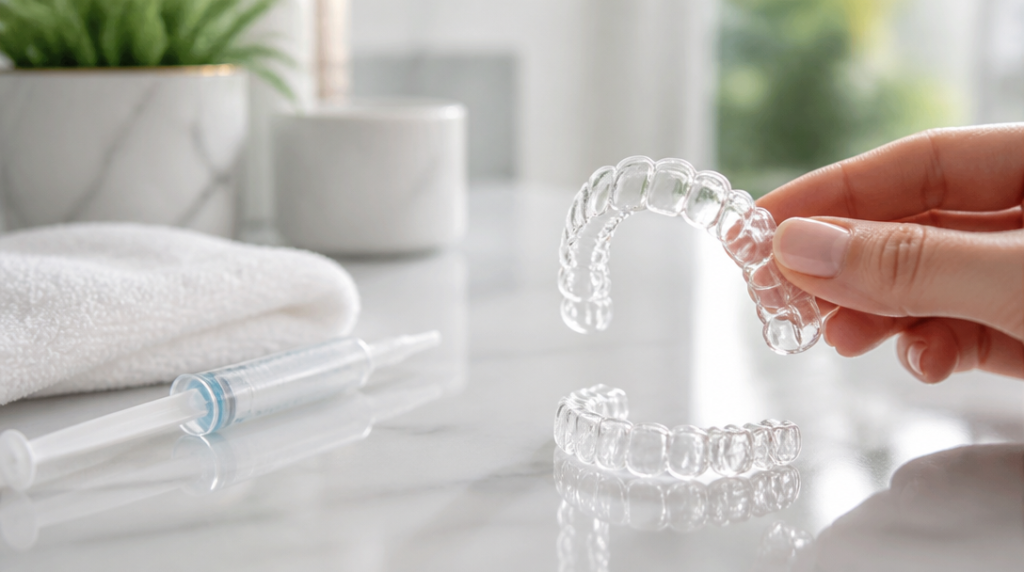
Why Peroxide Whitening Speeds Up as It Warms
The Whitening Temperature Reaction: Why Heat Controls How Fast Peroxide Works The whitening temperature reaction is the variable most people never consider — yet it quietly determines whether a whitening session delivers real results or wastes your time. Peroxide percentage and wear time get all the attention, but the temperature of the gel and the … Read more
The Whitening Temperature Reaction: Why Heat Controls How Fast Peroxide Works
The whitening temperature reaction is the variable most people never consider — yet it quietly determines whether a whitening session delivers real results or wastes your time. Peroxide percentage and wear time get all the attention, but the temperature of the gel and the tooth surface governs the actual speed of the chemistry. Two identical trays loaded with identical gel can produce noticeably different outcomes simply because one was applied to a warm mouth and the other immediately after a cold drink.
This is the insight most whitening content skips entirely. Peroxide whitening is not a fixed-speed process. It is a temperature-dependent reaction that accelerates with heat and slows without it — and understanding that distinction changes how you whiten.
How Peroxide Breaks Stains: The Radical Reaction Made Clear
Hydrogen peroxide and carbamide peroxide both work by releasing reactive oxygen. When peroxide decomposes, it generates unstable oxygen-containing molecules called free radicals. These radicals seek out the large, colored organic molecules — chromogens — that have built up inside your enamel and dentin over years of coffee, red wine, tobacco, and pigmented foods.
The radicals attack double bonds inside those chromogen molecules. Breaking those bonds shortens the molecule and disrupts its ability to absorb visible light. A molecule that once appeared brown or yellow becomes smaller, less conjugated, and effectively colorless. Your enamel is not coated white — the stain molecules are chemically dismantled from the inside.
Carbamide peroxide adds an extra step: it first breaks down into hydrogen peroxide, which then does the oxidizing work. Roughly one-third of carbamide peroxide’s mass converts to active hydrogen peroxide, which is why a gel labeled as 6% carbamide is considerably milder than a 6% hydrogen peroxide gel.
Temperature enters the equation because generating and mobilizing these radicals is a chemical reaction — and reaction rates respond directly to heat. More thermal energy means peroxide molecules decompose more readily and free radicals diffuse faster into the enamel matrix where chromogens are hiding.
The Q10 Rule and the Whitening Temperature Reaction

Chemists use a concept called the Q10 temperature coefficient to describe how reaction rate changes with heat. For many biological and chemical oxidation reactions, a 10°C increase in temperature roughly doubles the reaction rate. Peroxide decomposition follows this pattern closely, which is the scientific foundation behind heat-accelerated whitening.
Consider what this means in a real mouth. A gel stored in a cool bathroom drawer might sit near 18–20°C. Body temperature inside a closed mouth is approximately 37°C. That gap of roughly 17°C can more than double the effective reaction speed as the gel warms toward your oral environment during treatment.
This is why manufacturers correctly state that gentle heat acts as a catalyst for hydrogen peroxide — warmth increases both the reaction rate and peroxide’s penetration into enamel without degrading the gel, provided the temperature stays moderate. The word moderate carries significant weight here.
The safety ceiling matters as much as the benefit. Gel and tooth temperatures should stay below approximately 128°F (53°C) to avoid enamel damage and pulp inflammation. Below that threshold, you are accelerating a controlled chemical reaction. Above it, you risk damaging sensitive oral tissues and inflaming the nerve inside the tooth.
There is one critical nuance people routinely invert. Heat accelerates the whitening temperature reaction during use, but heat during storage is destructive. Elevated storage temperatures decrease peroxide concentration in bleaching gels over time, meaning a gel left in a hot car loses potency before you ever apply it. Warm during use, cool during storage — these two facts are not contradictory; they describe two entirely different stages of the process.
Photo by Terrance Barksdale on Pexels
What Happens When You Insert a Fridge-Cold Tray
Refrigerating peroxide gel is chemically sound for preservation — cool temperatures slow the decomposition that quietly weakens your gel over time. The problem arises when people pull that cold gel directly from the refrigerator, insert the tray, and start timing immediately, assuming the whitening reaction begins at full strength. It does not.
When a cold tray contacts your teeth, the gel is temporarily far below body temperature. During those first several minutes, the reaction runs sluggishly because the peroxide is cold and slow to release radicals. Your mouth must first warm the gel toward 37°C before the whitening temperature reaction reaches its intended pace.
In practical terms, a fridge-cold application wastes part of your treatment window on a thermal warm-up phase. If you whiten for 20 minutes and the first five minutes are spent equilibrating temperature, you have effectively shortened your active whitening period without realizing it. This hidden delay explains why some users feel a kit “isn’t working” even when the protocol looks correct on paper.
The smarter approach is straightforward: let refrigerated gel sit at room temperature for 10 to 15 minutes before applying it, or store your active-use supply at room temperature and refrigerate only long-term backups. The gel then reaches reactive temperature almost immediately once it contacts your teeth, giving you a full and consistent treatment window from the first minute.
This same principle explains uneven results in some users. A cold tray that warms unevenly — faster near the gumline where blood flow is richer, slower at the tips of teeth — can produce patchy lightening because the whitening temperature reaction is proceeding at different rates across the same smile.
LED “Activation” Claims: Partly Real, Partly Hype
Nearly every consumer whitening kit now bundles an LED device marketed as an accelerator. The truth sits uncomfortably between the promotional language and the skepticism, and honest reporting requires addressing both sides clearly.
The critical evidence is real: research reviews note that while some products claim heat increases chromogen oxidation to speed the reaction, light activation itself shows no consistent bleaching improvement in controlled studies. Blue LED light alone does not appear to add meaningful whitening beyond what the peroxide already delivers. Many dental researchers consider the light largely cosmetic in its contribution.
Where the “partly real” argument holds is in heat. Some LED and lamp systems generate mild warmth as a byproduct, and it is that gentle temperature rise — not the light wavelength — that can nudge the whitening temperature reaction faster through the same Q10 thermodynamic effect described earlier. A device that warms the gel slightly toward the safe ceiling may produce a modest speed benefit attributable to temperature, not photochemistry.
That distinction reframes the entire product category. A light source that generates controlled warmth may help through thermodynamics. A cool LED producing only visible blue light likely contributes little beyond placebo confidence. When evaluating a device, ask whether the active mechanism is warmth — which is plausible and supported — or “light-activated chemistry” — which remains largely unsupported for standard peroxide systems.
The Sensitivity Tradeoff: When a Faster Whitening Temperature Reaction Backfires
Accelerating the reaction with warmth sounds purely advantageous until the nerve inside your tooth enters the conversation. The pulp — living tissue containing nerves and blood vessels — sits just beneath dentin, and it responds to both thermal changes and the peroxide byproducts diffusing toward it during treatment.
A faster reaction means more reactive oxygen species generated in less time. Some of these penetrate through enamel and dentin toward the pulp, producing the sharp, transient sensitivity that whitening users know well. Add elevated temperature on top and you compound two irritants simultaneously: chemical stress from oxidation and thermal stress from heat. The result is a significant spike in discomfort risk.
This is precisely why concentration and timing discipline matter more at higher gel strengths. Very high-concentration products demand careful time management because the reaction is already aggressive at room temperature. Layering heat onto that scenario dramatically elevates the sensitivity risk and the margin for error narrows considerably.
The evidence increasingly favors the gentler route for most users. Research has found that 6% hydrogen peroxide used for 30 minutes daily over two weeks can whiten more effectively than some high-concentration in-office treatments, and dental experts generally advise against consumer use of hydrogen peroxide above 6%. The practical takeaway: you do not need extreme heat or extreme concentration to achieve excellent results. Pushing both variables simultaneously is where the whitening temperature reaction shifts from helpful to harmful.
The ADA and professional dental guidance recognize hydrogen peroxide as safe in over-the-counter products up to 3.5%, with concentrations between 3% and 6% considered appropriate under professional supervision. Exceeding those thresholds without clinical oversight raises meaningful oral health risks. You can learn more about safe peroxide concentrations for at-home whitening and when to involve a dentist in your protocol.
When sensitivity does appear, the standard professional recommendation is to pause — not push through. Structured whitening cycles with planned rest days, using moderate concentrations around 6% carbamide peroxide, allow the pulp to recover between sessions rather than accumulating cumulative chemical and thermal stress.
Practical Temperature Tips for Safer, More Effective Results at Home
Applying what you know about the whitening temperature reaction does not require special equipment. A few deliberate habits translate the chemistry into better results and fewer side effects.
- Store gels cool, apply them warm. Refrigerate long-term supplies to preserve peroxide concentration, but bring the day’s gel to room temperature before each session so the whitening temperature reaction is active from the first minute of contact — not after a cold warm-up delay.
- Never store gel in heat. A hot car, sunny windowsill, or bathroom radiator degrades peroxide concentration in bleaching gels before they are ever used. This is the opposite of the beneficial warmth during application and the two scenarios should not be confused.
- Avoid whitening immediately after ice-cold drinks. A chilled mouth temporarily slows the reaction and can worsen thermal sensitivity when the gel contacts already-stressed enamel. Wait a few minutes for your oral temperature to normalize.
- Do not attempt to heat gel with hot water or external devices. You cannot reliably control temperature that way, and crossing the approximately 128°F safety ceiling risks enamel damage and pulp inflammation. Your own body warmth is the safe, self-limiting heat source — the system is already engineered around it.
- Match your protocol to your sensitivity level. If your nerve response is reactive, choose lower concentrations, standard room-temperature applications, and shorter initial sessions. Whitening speed is optional; protecting the pulp is not.
- Favor contact time over aggressive heat for stubborn stains. Whitening strips remain among the most effective over-the-counter options primarily because they maintain close enamel contact over longer periods with adequate peroxide concentration — not because of any thermal advantage. Extended, controlled exposure frequently outperforms short, aggressive sessions.
- Use desensitizing support proactively. A potassium nitrate toothpaste used before and after whitening sessions can calm the nerve response that a faster or warmer whitening temperature reaction can provoke, reducing the likelihood of sensitivity interrupting your cycle.
For a complete guide on managing tooth sensitivity during whitening protocols, see how to prevent and treat whitening-related tooth sensitivity.
The Unifying Principle: Control Is the Strategy
Every practical tip above points toward the same conclusion. Gentle warmth supplied by your own body accelerates the whitening temperature reaction safely and efficiently. Uncontrolled external heat and excessive peroxide concentration invite damage that no amount of extra whitening time can undo.
The chemistry is on your side when you respect the safety ceiling, let biology supply the warmth, and treat concentration as a variable to manage rather than maximize. The users who get the most consistent results are not the ones using the strongest products under the hottest lights — they are the ones who understand what drives the reaction and remove the variables working against them.
Temperature is one of those variables. Now you know how to use it.
For a broader look at how gel formulation affects the whitening temperature reaction and overall efficacy, explore how to choose the right peroxide whitening gel for your goals.

Photo by hello aesthe on Pexels
References
1. GLO Science. How Heat Can Improve Teeth Whitening. GLO Science Blog. Available at: https://gloscience.com/blogs/blog/how-heat-can-improve-teeth-whitening
2. Carey CM. Tooth Whitening: What We Now Know. Journal of Evidence-Based Dental Practice. 2014;14 Suppl:70–76. Available via PubMed Central: https://pmc.ncbi.nlm.nih.gov/articles/PMC4058574/
3. Biomed Research International / BJSTR. Storage Temperature Influences Peroxide Concentration in Bleaching Gels. Available at: https://biomedres.us/pdfs/BJSTR.MS.ID.001750.pdf
4. Healthline. Does Hydrogen Peroxide Whiten Teeth? Reviewed by dental professionals. Available at: https://www.healthline.com/health/hydrogen-peroxide-teeth-whitening
5. Frontiers in Dental Medicine. Tooth Whitening: An Overview of Products and Techniques. 2021. Available at: https://www.frontiersin.org/journals/dental-medicine/articles/10.3389/fdmed.2021.687507/full
6. Gentle Dental. Hydrogen Peroxide Teeth Whitening: Expert Tips and Safety Guidelines. Available at: https://www.gentledental.com/resources/articles/hydrogen-peroxide-teeth-whitening
Disclaimer
This article is for informational purposes only. LLRNCARE makes no representations or warranties about the completeness, accuracy, reliability of the information. Any reliance is at your own risk.
For professional dental advice, consult a qualified dental professional. For regulatory compliance, consult legal experts.